IFAW Applauds Congresswoman Boyda’S (D-Ks) Initiative To Prevent Further Tragedies From Direct Public Contact With Captive Big Cats
http://www.ifaw.org/ifaw/general/default.aspx?oid=219353
Tuesday, August 28, 2007
Monday, June 04, 2007
The lion project people give their side of the story to Gill Staden...
The Lion Project
You probably remember that there was a scoping meeting for the proposed Lion Project in Dambwa Forest. As a quick rundown ...
The 'Walking with Lions' activity for tourists which operates in Vic Falls, Zimbabwe, is to be brought over to Livingstone. The lions can walk with tourists from a few weeks up to the age of 18 months, after which time the lions are replaced by other younger lion cubs. The 18-month old lions are taken to a sanctuary (in our case, Dambwa Forest) The sanctuary is securely fenced off by an electric fence. The lion sanctuary includes other game so that the lions can learn to hunt and feed themselves. They are given supplementary food to make sure that they are properly fed. The lions are allowed to breed and these cubs are brought up without human contact. The hope is that these cubs or their offspring can be released back into the wild.
I had a few concerns which I emailed Dave Youldan about, and here is his response: As I said at the meeting we have always, and will continue to invite concerns to be aired about our project. It is through these raised concerns that we have been able to hone our release protocols and policies.
Firstly, is walking with lions ethical?
We have received a lot of support for the aims of the project as well letters of approval for the “highly ethical and extremely well managed” methods employed in the raising & rehabilitation of lions from notable individuals and organizations including: Dr R D Taylor, Director of WWF’s Southern Africa region, the Zambian wildlife authority, the Zimbabwean National Society for the Prevention of Cruelty to Animals, Zimbabwe Parks & Wildlife Management Authority, Mr V Booth, independent ecologist, Dr Pieter Kat, consultant ecologist, Mr Norman Monks, Senior Warden for Zimbabwean Parks & Wildlife and Sarel van der Merwe, Chairman African Lion Working Group (IUCN / SSC). In addition, our program is registered with PAAZAB and last year we were invited to apply for IUCN membership.
Dr Pieter Kat – “...we can begin programs of lion reintroduction in a wide variety of depopulated areas. Such programs will not only be immediately positive, but will also place lions squarely in the category of animals like rhinos whose plight seems to be better appreciated by the international conservation community. This is why I am appreciative and excited to be involved by the initiatives taken by Andrew and Wendy Conolly. Through years of self-funded and determined effort, they have developed a program of re-introduction that has a very good chance of success. Predators of any description are notoriously difficult to reintroduce, but now we have at least a workable plan. As I said, the future of African lions is in African hands. Let us salute those who have been steadfast to ensure this future, and recognize that any action is better than the currently looming extinction of an African icon if we do nothing.”
Dr Sarel van der Merve – “Generally speaking, the feeling amongst scientists are that captive bred lions cannot survive in a natural environment. I beg to differ. I have reviewed too many reports to the contrary….I believe one can rehabilitate the lions”
Vernon Booth – “I have done some research regarding the re-introduction of lions in RSA and was pleasantly surprised to see that this was feasible and had been done successfully”
Norman Monks – “I am...exited about rehabilitation of lions back into the wild and I know that this can happen”
One issue here is whether removing the cubs from their mothers causes undue stress to the mother and cubs. In stage one the cubs born in our breeding centre are taken from their mother at 3 weeks old. We have observed over the years that cubs are very quick to see a handler assigned to raise them as the dominant member of the pride and start suckling and playing in a completely relaxed way within a couple of hours, and unusually up to 18 hours. The mothers are never overly stressed by this practice and we observe their behaviour returning to completely normal in their usual social groups within 24 hours. Removing the cubs at this age allows us to train the lions only to the point that they are safe for us to take out on walks from 6 weeks to 18 months old. This gives the lions the opportunity to experience their natural environment.
Inviting eco-tourists to join the walks serves three purposes. The principal one is that we are able to take the lions out for many more hours in a day. As a result our research has shown a dramatic increase in the lions’ hunting ability which improves their chances of success. The walks also increase awareness of the plight of the lion, as well as raising funding for the release sites.
Lion gene pool - how does this affect lion populations in general?
Our genetics policy has been put together with the assistance of Jean Dubach of the Chicago Zoological Society and author of the paper Molecular genetic variation across the southern and eastern geographic ranges of the African lion, as well as our consultant ecologist Dr Pieter Kat. Finally, we are following the IUCN / SSC Guidelines on reintroductions.
Firstly, let’s deal with the claim that our lions are a genetic Heinz variety cobbled together from zoos and other places across Africa. This simply is not the case and we are somewhat bewildered how such claims have been made from people with no knowledge of the origin of our lions or their DNA testing results. All the lions in our program were born in Zimbabwe. We have in the past had a male from Tanzania who bred with some of our Zimbabwean lions. The Tanzanian lion was of the same haplotype as the lions he was bred with and therefore follows sound genetic protocols.
We have taken a lot of advice on the issue of genetics, and that advice ranges from ignoring the issue entirely as the genetic difference between lions across the continent is so small as to not matter, up to no lion can ever be moved because even the most insignificant genetic difference is enough. With our consultants we have decided to take a cautionary stance on genetics with the policy “translocations to increase genetic diversity would mimic natural gene flow by moving only individuals from the nearest areas with similar haplotypes”
To date evidence shows that Zambian lions fall into the haplotype that categorizes Eastern & Southern African lions which includes much of Kenya, Tanzania, Zambia, Mozambique and eastern South Africa. One study has suggested that Zimbabwean lions are more closely linked with the haplotype found in Botswana and Namibia. However, these studies are based on only 1 or 2 samples, and recent DNA testing of our lions by Jean Dubach contradicts those previous findings, placing our lions in the same haplotype as those found in the Eastern & Southern African grouping, and therefore compatible with Zambian lions. It has also been suggested that, in genetic terms, Zimbabwean lions were part of the same meta-population as those in Zambia until recently, in genetic terms.
How many lions are going to be bred and what are their final destinations?
The number of lions to be bred will depend on the demand for lions in stage four of our release program. At present we are being cautious and are only breeding sufficient to stock our initial stage three release plans, however with 2 sites confirmed and a further 9 having been asked of us, we are currently well behind the breeding level for these sites. This is a conscious decision to make sure we have the protocols for these first 2 stage three release sites correct. Once we are happy with that we can increase breeding to stock the remaining planned stage three sites. Breeding within our program at all stages of the program can and will be carefully controlled to breed lions only to meet the demand in stage four. We have a significant number of requests for stage four releases both from governments and from private reserves, however, we are again being cautious as we want to make sure stage three is working as expected before increasing breeding to meet this demand.
In practical terms, so far in 2007 only two females have been allowed to breed, one producing a litter of 5, the other a litter of 2. We have no breeding plans until later in the year when a further two lions will be allowed to breed.
How can you monitor the lions when they have left your control, the major concern being canned hunting?
All of our lions will be collared at release as well as micro-chipped for identification, and we will be conducting research on the released lions so they will be monitored closely. As we have done in the past, contracts will be drawn up that forbid hunting of our lions for any reason. It is clear that illegal hunting cannot be controlled and we will almost certainly lose some lions for this reason, also we will have to rely on the legal framework of the release country in order to enforce the no hunting clause in the contract, however we believe we are taking reasonable measures to ensure our lions do not end up in canned hunting.
With regards our export of lions to South Africa, some 37 lions were sold, in two groups, one in 1999 and the majority in 2002 to a captive centre in South Africa. All lions in the second sale were micro-chipped. The pertinent details are that the export permits and agreements drawn up for the sale by the Zimbabwean Parks & Wildlife Authority required that the lions could never be hunted in any form and that the South African wildlife authorities were responsible for monitoring the status of the lions after sale to ensure the agreements were upheld. As we became aware of the country-wide rise of canned hunting in South Africa a decision was made to cease any further exports to the country until the legal situation changed.
We support any move to make canned hunting illegal in all countries.
To bring in a few other points, the reintroduction of lions has proved unsuccessful to date for four reasons.
1. that the animals were given no pre-release training,
2. that their reliance on humans was not curtailed,
3. that lions were released as individuals with no natural pride social organization,
4. and that they had no experience of competitive and predatory species.
Without repeating the information about each stage of the program, you can see that we have tried to tackle each of these issues within our first three stages of the program to ensure that the lions born in stage three and released into stage four are as prepared as possible. Most people focus on the stage three release as being our end goal. It is not, and try as I might to get this message across in film, print and by talking to people, the message does not seem to be getting through – we must do better at this. Our goal is to rehabilitate captive bred lions so they can survive without human intervention in an artificially created eco-system, as close as possible to their wild environment such that they can teach their cubs in a natural way. Those cubs will essentially be wild cubs with no experience of humans, born and raised in a natural pride social group, within as wild an environment as we are able to create for them. We believe that these cubs will grow up with all the skills necessary to survive in the wild in stage four, without any of the problems faced by previous attempts to release lions which were from a purely captive environment to a wild one. So the only question is whether our program sufficiently prepares our lions to be able to survive in stage three such that they can teach their cubs to survive in stage four. Evidence from our program to date suggests that we are getting it right, and as you will have read in the quotes from letters and emails we have received from notable ecologists and experts, others believe we have gotten it right as well.
As for our broader program, and the claim that our goals of community involvement and conservation of the broader eco-system were unachievable, I would make one point. The concern was raised without any reference to the context within which these benefits could be achieved. The concern assumed that we are responsible for all of those programs that we mentioned that could benefit the community. Many of those programs are already in action through the Joint Management Plan between Forestry and the communities surrounding Dambwa. We believe, as a stakeholder in Dambwa that we should play our part in assisting in that existing program, and by bringing additional funding and manpower that we can help make those existing programs more effective and bring results quicker than is currently expected. This point, even though I made it verbally and visually in the presentation was ignored by the person raising the concern, in my opinion, in favour of grandstanding. We are already doing a huge amount for the local communities within Livingstone through our eco-tourism program working in a number of schools, medical clinics, orphanages, home help programs and with the elephant pepper project. We have already started our community program in advance of bringing the lions and have invested large amounts of money in building new classrooms, providing medical supplies, teaching aids etc etc. Our next plan is to extend our community programs to assist the communities specifically surrounding Dambwa. Our conservation and research programs are already underway in Zimbabwe in a number of the National Parks and covering a range of species. We will be copying this already successful program within Zambia when the lions move across. So, I find it difficult to understand how a claim can be made that we cannot achieve our goals without first looking at what they are and finding out how we intend to achieve them through funding and manpower, a model that we have already shown is successful in Zimbabwe.
The final point that I am going to raise in this email is that of why are we bothering with this program at all? Why not just put the money into beefing up legal protection of the species and its habitat. There is a simple answer to this and that is that the millions of dollars already spent by far more influential organizations than ours over many years have failed almost completely in this regard. For all the money poured into such programs the populations of lion as well as other species are still declining. We believe that we should not make the same mistakes of the past. Why wait for the inevitable to happen – the last few remaining lions with a very small gene pool, protected, but inevitably heading towards extinction. We believe that we can create a release program that can work, and can be one of a number of solutions to the problems faced by the lion. And we want to do this now so the plan is already in place and known to work before the number of lions gets down to critical level – is there anyone who does not believe that this will happen?
I do hope that I have helped to inform you better about our program, and have covered your concerns in enough detail. If I have not, please believe it is not intended as a way of hiding something. I would gladly expand on any point raised as well as any others that may arise.
In response to this email I wrote:
I just have one more question for you:
The lions which are used for the 'Walking with Lions' walk with clients for 18 months, and I believe that there are 10 of them. So that means that every 18 months 'Walking with Lions' requires 10 lions, and 10 lions have to be 're-homed'. A lion lives for between 15 and 24 years. So, by my estimate, you will have about 100 lions which have been walking with people and need to be looked after in captivity. The concern is that these lions are looked after properly and not sold on to zoos, canned hunting, etc. So what happens to them?
With regards to what happens with the lions once no longer walking in stage one…at that age, as is the case now while we build our release areas, if there is no stage two release site ready, the lions are returned to holding enclosures where the animals can be held in suitable enclosures awaiting release. As is the situation now, lions up to 2 years and 4 months old can be taken out to hone their hunting skills. This is done by vehicle. We are able to do this at the Park as we are an enclosed area, and one of the areas in Dambwa is being built for this purpose. Once we have our stage two and three release sites fully operational we will only be breeding at a level that our release sites can support, and if we have to shut down any part of stage one such that we do not have lions retired from stage one with nowhere to go, then we have always stated that we will do that.
If anyone has questions that need answers about the project, let me have them, and I will pass them on.
I have been invited to go and have a look at their lion project in Gweru which I intend to do, so will tell you more after the visit.
You probably remember that there was a scoping meeting for the proposed Lion Project in Dambwa Forest. As a quick rundown ...
The 'Walking with Lions' activity for tourists which operates in Vic Falls, Zimbabwe, is to be brought over to Livingstone. The lions can walk with tourists from a few weeks up to the age of 18 months, after which time the lions are replaced by other younger lion cubs. The 18-month old lions are taken to a sanctuary (in our case, Dambwa Forest) The sanctuary is securely fenced off by an electric fence. The lion sanctuary includes other game so that the lions can learn to hunt and feed themselves. They are given supplementary food to make sure that they are properly fed. The lions are allowed to breed and these cubs are brought up without human contact. The hope is that these cubs or their offspring can be released back into the wild.
I had a few concerns which I emailed Dave Youldan about, and here is his response: As I said at the meeting we have always, and will continue to invite concerns to be aired about our project. It is through these raised concerns that we have been able to hone our release protocols and policies.
Firstly, is walking with lions ethical?
We have received a lot of support for the aims of the project as well letters of approval for the “highly ethical and extremely well managed” methods employed in the raising & rehabilitation of lions from notable individuals and organizations including: Dr R D Taylor, Director of WWF’s Southern Africa region, the Zambian wildlife authority, the Zimbabwean National Society for the Prevention of Cruelty to Animals, Zimbabwe Parks & Wildlife Management Authority, Mr V Booth, independent ecologist, Dr Pieter Kat, consultant ecologist, Mr Norman Monks, Senior Warden for Zimbabwean Parks & Wildlife and Sarel van der Merwe, Chairman African Lion Working Group (IUCN / SSC). In addition, our program is registered with PAAZAB and last year we were invited to apply for IUCN membership.
Dr Pieter Kat – “...we can begin programs of lion reintroduction in a wide variety of depopulated areas. Such programs will not only be immediately positive, but will also place lions squarely in the category of animals like rhinos whose plight seems to be better appreciated by the international conservation community. This is why I am appreciative and excited to be involved by the initiatives taken by Andrew and Wendy Conolly. Through years of self-funded and determined effort, they have developed a program of re-introduction that has a very good chance of success. Predators of any description are notoriously difficult to reintroduce, but now we have at least a workable plan. As I said, the future of African lions is in African hands. Let us salute those who have been steadfast to ensure this future, and recognize that any action is better than the currently looming extinction of an African icon if we do nothing.”
Dr Sarel van der Merve – “Generally speaking, the feeling amongst scientists are that captive bred lions cannot survive in a natural environment. I beg to differ. I have reviewed too many reports to the contrary….I believe one can rehabilitate the lions”
Vernon Booth – “I have done some research regarding the re-introduction of lions in RSA and was pleasantly surprised to see that this was feasible and had been done successfully”
Norman Monks – “I am...exited about rehabilitation of lions back into the wild and I know that this can happen”
One issue here is whether removing the cubs from their mothers causes undue stress to the mother and cubs. In stage one the cubs born in our breeding centre are taken from their mother at 3 weeks old. We have observed over the years that cubs are very quick to see a handler assigned to raise them as the dominant member of the pride and start suckling and playing in a completely relaxed way within a couple of hours, and unusually up to 18 hours. The mothers are never overly stressed by this practice and we observe their behaviour returning to completely normal in their usual social groups within 24 hours. Removing the cubs at this age allows us to train the lions only to the point that they are safe for us to take out on walks from 6 weeks to 18 months old. This gives the lions the opportunity to experience their natural environment.
Inviting eco-tourists to join the walks serves three purposes. The principal one is that we are able to take the lions out for many more hours in a day. As a result our research has shown a dramatic increase in the lions’ hunting ability which improves their chances of success. The walks also increase awareness of the plight of the lion, as well as raising funding for the release sites.
Lion gene pool - how does this affect lion populations in general?
Our genetics policy has been put together with the assistance of Jean Dubach of the Chicago Zoological Society and author of the paper Molecular genetic variation across the southern and eastern geographic ranges of the African lion, as well as our consultant ecologist Dr Pieter Kat. Finally, we are following the IUCN / SSC Guidelines on reintroductions.
Firstly, let’s deal with the claim that our lions are a genetic Heinz variety cobbled together from zoos and other places across Africa. This simply is not the case and we are somewhat bewildered how such claims have been made from people with no knowledge of the origin of our lions or their DNA testing results. All the lions in our program were born in Zimbabwe. We have in the past had a male from Tanzania who bred with some of our Zimbabwean lions. The Tanzanian lion was of the same haplotype as the lions he was bred with and therefore follows sound genetic protocols.
We have taken a lot of advice on the issue of genetics, and that advice ranges from ignoring the issue entirely as the genetic difference between lions across the continent is so small as to not matter, up to no lion can ever be moved because even the most insignificant genetic difference is enough. With our consultants we have decided to take a cautionary stance on genetics with the policy “translocations to increase genetic diversity would mimic natural gene flow by moving only individuals from the nearest areas with similar haplotypes”
To date evidence shows that Zambian lions fall into the haplotype that categorizes Eastern & Southern African lions which includes much of Kenya, Tanzania, Zambia, Mozambique and eastern South Africa. One study has suggested that Zimbabwean lions are more closely linked with the haplotype found in Botswana and Namibia. However, these studies are based on only 1 or 2 samples, and recent DNA testing of our lions by Jean Dubach contradicts those previous findings, placing our lions in the same haplotype as those found in the Eastern & Southern African grouping, and therefore compatible with Zambian lions. It has also been suggested that, in genetic terms, Zimbabwean lions were part of the same meta-population as those in Zambia until recently, in genetic terms.
How many lions are going to be bred and what are their final destinations?
The number of lions to be bred will depend on the demand for lions in stage four of our release program. At present we are being cautious and are only breeding sufficient to stock our initial stage three release plans, however with 2 sites confirmed and a further 9 having been asked of us, we are currently well behind the breeding level for these sites. This is a conscious decision to make sure we have the protocols for these first 2 stage three release sites correct. Once we are happy with that we can increase breeding to stock the remaining planned stage three sites. Breeding within our program at all stages of the program can and will be carefully controlled to breed lions only to meet the demand in stage four. We have a significant number of requests for stage four releases both from governments and from private reserves, however, we are again being cautious as we want to make sure stage three is working as expected before increasing breeding to meet this demand.
In practical terms, so far in 2007 only two females have been allowed to breed, one producing a litter of 5, the other a litter of 2. We have no breeding plans until later in the year when a further two lions will be allowed to breed.
How can you monitor the lions when they have left your control, the major concern being canned hunting?
All of our lions will be collared at release as well as micro-chipped for identification, and we will be conducting research on the released lions so they will be monitored closely. As we have done in the past, contracts will be drawn up that forbid hunting of our lions for any reason. It is clear that illegal hunting cannot be controlled and we will almost certainly lose some lions for this reason, also we will have to rely on the legal framework of the release country in order to enforce the no hunting clause in the contract, however we believe we are taking reasonable measures to ensure our lions do not end up in canned hunting.
With regards our export of lions to South Africa, some 37 lions were sold, in two groups, one in 1999 and the majority in 2002 to a captive centre in South Africa. All lions in the second sale were micro-chipped. The pertinent details are that the export permits and agreements drawn up for the sale by the Zimbabwean Parks & Wildlife Authority required that the lions could never be hunted in any form and that the South African wildlife authorities were responsible for monitoring the status of the lions after sale to ensure the agreements were upheld. As we became aware of the country-wide rise of canned hunting in South Africa a decision was made to cease any further exports to the country until the legal situation changed.
We support any move to make canned hunting illegal in all countries.
To bring in a few other points, the reintroduction of lions has proved unsuccessful to date for four reasons.
1. that the animals were given no pre-release training,
2. that their reliance on humans was not curtailed,
3. that lions were released as individuals with no natural pride social organization,
4. and that they had no experience of competitive and predatory species.
Without repeating the information about each stage of the program, you can see that we have tried to tackle each of these issues within our first three stages of the program to ensure that the lions born in stage three and released into stage four are as prepared as possible. Most people focus on the stage three release as being our end goal. It is not, and try as I might to get this message across in film, print and by talking to people, the message does not seem to be getting through – we must do better at this. Our goal is to rehabilitate captive bred lions so they can survive without human intervention in an artificially created eco-system, as close as possible to their wild environment such that they can teach their cubs in a natural way. Those cubs will essentially be wild cubs with no experience of humans, born and raised in a natural pride social group, within as wild an environment as we are able to create for them. We believe that these cubs will grow up with all the skills necessary to survive in the wild in stage four, without any of the problems faced by previous attempts to release lions which were from a purely captive environment to a wild one. So the only question is whether our program sufficiently prepares our lions to be able to survive in stage three such that they can teach their cubs to survive in stage four. Evidence from our program to date suggests that we are getting it right, and as you will have read in the quotes from letters and emails we have received from notable ecologists and experts, others believe we have gotten it right as well.
As for our broader program, and the claim that our goals of community involvement and conservation of the broader eco-system were unachievable, I would make one point. The concern was raised without any reference to the context within which these benefits could be achieved. The concern assumed that we are responsible for all of those programs that we mentioned that could benefit the community. Many of those programs are already in action through the Joint Management Plan between Forestry and the communities surrounding Dambwa. We believe, as a stakeholder in Dambwa that we should play our part in assisting in that existing program, and by bringing additional funding and manpower that we can help make those existing programs more effective and bring results quicker than is currently expected. This point, even though I made it verbally and visually in the presentation was ignored by the person raising the concern, in my opinion, in favour of grandstanding. We are already doing a huge amount for the local communities within Livingstone through our eco-tourism program working in a number of schools, medical clinics, orphanages, home help programs and with the elephant pepper project. We have already started our community program in advance of bringing the lions and have invested large amounts of money in building new classrooms, providing medical supplies, teaching aids etc etc. Our next plan is to extend our community programs to assist the communities specifically surrounding Dambwa. Our conservation and research programs are already underway in Zimbabwe in a number of the National Parks and covering a range of species. We will be copying this already successful program within Zambia when the lions move across. So, I find it difficult to understand how a claim can be made that we cannot achieve our goals without first looking at what they are and finding out how we intend to achieve them through funding and manpower, a model that we have already shown is successful in Zimbabwe.
The final point that I am going to raise in this email is that of why are we bothering with this program at all? Why not just put the money into beefing up legal protection of the species and its habitat. There is a simple answer to this and that is that the millions of dollars already spent by far more influential organizations than ours over many years have failed almost completely in this regard. For all the money poured into such programs the populations of lion as well as other species are still declining. We believe that we should not make the same mistakes of the past. Why wait for the inevitable to happen – the last few remaining lions with a very small gene pool, protected, but inevitably heading towards extinction. We believe that we can create a release program that can work, and can be one of a number of solutions to the problems faced by the lion. And we want to do this now so the plan is already in place and known to work before the number of lions gets down to critical level – is there anyone who does not believe that this will happen?
I do hope that I have helped to inform you better about our program, and have covered your concerns in enough detail. If I have not, please believe it is not intended as a way of hiding something. I would gladly expand on any point raised as well as any others that may arise.
In response to this email I wrote:
I just have one more question for you:
The lions which are used for the 'Walking with Lions' walk with clients for 18 months, and I believe that there are 10 of them. So that means that every 18 months 'Walking with Lions' requires 10 lions, and 10 lions have to be 're-homed'. A lion lives for between 15 and 24 years. So, by my estimate, you will have about 100 lions which have been walking with people and need to be looked after in captivity. The concern is that these lions are looked after properly and not sold on to zoos, canned hunting, etc. So what happens to them?
With regards to what happens with the lions once no longer walking in stage one…at that age, as is the case now while we build our release areas, if there is no stage two release site ready, the lions are returned to holding enclosures where the animals can be held in suitable enclosures awaiting release. As is the situation now, lions up to 2 years and 4 months old can be taken out to hone their hunting skills. This is done by vehicle. We are able to do this at the Park as we are an enclosed area, and one of the areas in Dambwa is being built for this purpose. Once we have our stage two and three release sites fully operational we will only be breeding at a level that our release sites can support, and if we have to shut down any part of stage one such that we do not have lions retired from stage one with nowhere to go, then we have always stated that we will do that.
If anyone has questions that need answers about the project, let me have them, and I will pass them on.
I have been invited to go and have a look at their lion project in Gweru which I intend to do, so will tell you more after the visit.


Monday, May 14, 2007
Lionscam in Livingstone… by I.P.A. Manning
Livingstone, Zambia, was recently the battle site of some hard-headed developers and pragmatic conservationists. The developers came filled with the hubris of political power, laying their foundation stone before a shot was fired, attacking and imperiously claiming 220 ha. of land for their 18 hole golfing and housing estate in the Mosi-oa Tunya National Park – itself contained in the Victoria Falls World Heritage Site. But, standing in their way, were a few conservationists – mere individuals and mainly Zambians, and the rule of law and, we had hoped, the government departments responsible for natural resources protection whose genesis lies in the forestry and game departments of Magna Carta, bequeathed to us all of 792 years ago. That we stopped the golf course scheme was remarkable, testament, I suppose, to blog power and the encouragement and support of the one-time Warden of Mosi, Barry Shenton, who died on his farm in Mkushi not long after our victory.
Now, so it seems, history repeats itself: once more we must suffer the absurd and corrupt, the dangerous and scientifically gimcrack - suitably clothed of course as it always is in the garments of bogus good reason, of conservation and villager development claptrap, of greed and fulfillment at any cost. I allude here to a plan to remove lion cubs from their incarcerated mothers at the age of three weeks, to begin training them at six weeks of age to walk with humans in the Mosi oa Tunya NP, allowing them, if you can believe it, the opportunity until about 18 months old to hunt whatever beastie there they may encounter on their man led perambulations. This we are told in the briefest of rationales put out by Envsol consultants, on behalf of their client - some NGO called The African Lion & Environmental Trust, supported by a business going by the name of African Encounter, all now embraced under the name Lion Encounter (Zambia) Limited, will then advance to stage two where the lion will be confined in a 500 acre enclosure, now devoid of further human contact, so that they may develop into stable prides, and then be released into ‘managed ecosystems’ of around 10,000 acres devoid of other lion or humans, but, we are assured, where there will be much for them to hunt - though they will be in competition with other predators. Then, as the breathless document intones, cubs that result from these large free-ranging areas, will ‘develop skills that will enable their re-introduction into appropriate National parks and reserves across the African continent’ either as complete self-sustaining prides, or ‘female only prides’ that can be integrated with existing wild prides. And, of course, all of this will do this and that for all and sundry; the usual poorly defined, anti-climactic grabbing-at-straws ending to what will be a jolly old King of Beasts, money tingling romp after all. Perhaps it will also help global warming.
It is difficult to know whether to fall about with some temporary self-induced fit, or to just burst into tears. Certainly, anger, in our harvester assailed land, is no longer an option.
This scheme has been hanging around for some time. Various attempts to talk to some of the central characters came to nought, the Environmental Council of Zambia (ECZ) admitted that no EIA had been done, the Zambia Wildlife Authority (ZAWA) said that they wanted ‘cats’ in the Mosi, the bush telegraph said the ‘walking with lions’ chappies had been given the go-ahead and were actually building enclosures. Now we hear that ZAWA has given these people a Tourism Concession Agreement (TCA) in the Mosi , that the Forestry Department (both part of the Ministry of Tourism, Environment and Natural Resources) has given them a Forestry Concession Agreement (FCA) in the adjoining Dambwa Local Forest. So, clearly, they think the scheme is fine. Did not this happen before with the Legacy project? Perhaps we should be thankful that we and the local community are being ‘consulted’ here, for other forests – at least one National Forest, has simply been sold off for a pittance to ‘investors’ – without regard to the fact that the areas had originally been given to the Government for conservation purposes by the traditional owners of the land.
There are many questions, in no particular order: what happened to the moratorium placed by the Chairman of the ZAWA Board on all new developments in Mosi until such time as the IUCN development plan for the heritage site had been debated; what happened to the IUCN plan and, more importantly, to UNESCO itself – supposedly the legal guardian of the site; how be it possible for a scheme without a shred of conservation value - indeed, the complete reverse, being allowed to see the light of day; why was ZAWA’s own appointed lion researcher, Dr Paula White, not consulted by them prior to the issue of a concession being awarded in the Park; and why were Dr’s Anderson and Attwell – currently writing up a lion status study for Zambia on behalf of ZAWA, not asked to give their views.
This lion ‘four stage rehabilitation plan’ will almost certainly result in some of the following: distress to lion mothers; mayhem in the Mosi oa Tunya NP as young lion start their hunting careers under the tutelage of humans, confusing tourists on njingas (bicycles) and strolling Livingstone residents with other game, fair game, and allowing the immediate escape, by accident of course, of a member of this new lion cocktail set – they being a genetic Heinz variety of genes drawn from other parts of Africa, from zoos and so on; then allowing large numbers of these animals out into the wild, these semi-habituated lion-human Heinz varieties without fear and, like the villagers, permanently hungry, leading inevitably to death of one or the other and the pollution of our lion gene pool. And we will see canned lion hunting enter Zambia by stealth.
But there will be other effects, the law of unintended consequence once more raising its trident aloft to drive it into the holistic dumb ass. Following so closely on the heels of the Legacy imbroglio, this scheme, were it to come to fruition, would fan the coals of a tourism boycott of Livingstone and Zambia - the very industry on which efforts to allay poverty is based. And already in this country, we are assailed by industrial pollution, unhindered commercial game and elephant poaching, the destruction of our fish stocks by the endless mosquitoe nets parachuted in by muddle-headed donors, policies which promote the ivory trade despite the elephant carnage, the alienation to 99 year leases of National Forests, and so, on and on goes the list. And of course, an unwelcome result of this opposition to highly dodgy development in a developing democracy - already reeling from corruption, poverty and the lowest life expectancy rate in the world, is the misuse of the state machinery against the few individuals who dare to oppose and expose corruption and incompetence. Already, because of this, we have lost, and are losing, the sort of people and their families who guide society forward. This is the true and lasting impact of what is happening.
Now, so it seems, history repeats itself: once more we must suffer the absurd and corrupt, the dangerous and scientifically gimcrack - suitably clothed of course as it always is in the garments of bogus good reason, of conservation and villager development claptrap, of greed and fulfillment at any cost. I allude here to a plan to remove lion cubs from their incarcerated mothers at the age of three weeks, to begin training them at six weeks of age to walk with humans in the Mosi oa Tunya NP, allowing them, if you can believe it, the opportunity until about 18 months old to hunt whatever beastie there they may encounter on their man led perambulations. This we are told in the briefest of rationales put out by Envsol consultants, on behalf of their client - some NGO called The African Lion & Environmental Trust, supported by a business going by the name of African Encounter, all now embraced under the name Lion Encounter (Zambia) Limited, will then advance to stage two where the lion will be confined in a 500 acre enclosure, now devoid of further human contact, so that they may develop into stable prides, and then be released into ‘managed ecosystems’ of around 10,000 acres devoid of other lion or humans, but, we are assured, where there will be much for them to hunt - though they will be in competition with other predators. Then, as the breathless document intones, cubs that result from these large free-ranging areas, will ‘develop skills that will enable their re-introduction into appropriate National parks and reserves across the African continent’ either as complete self-sustaining prides, or ‘female only prides’ that can be integrated with existing wild prides. And, of course, all of this will do this and that for all and sundry; the usual poorly defined, anti-climactic grabbing-at-straws ending to what will be a jolly old King of Beasts, money tingling romp after all. Perhaps it will also help global warming.
It is difficult to know whether to fall about with some temporary self-induced fit, or to just burst into tears. Certainly, anger, in our harvester assailed land, is no longer an option.
This scheme has been hanging around for some time. Various attempts to talk to some of the central characters came to nought, the Environmental Council of Zambia (ECZ) admitted that no EIA had been done, the Zambia Wildlife Authority (ZAWA) said that they wanted ‘cats’ in the Mosi, the bush telegraph said the ‘walking with lions’ chappies had been given the go-ahead and were actually building enclosures. Now we hear that ZAWA has given these people a Tourism Concession Agreement (TCA) in the Mosi , that the Forestry Department (both part of the Ministry of Tourism, Environment and Natural Resources) has given them a Forestry Concession Agreement (FCA) in the adjoining Dambwa Local Forest. So, clearly, they think the scheme is fine. Did not this happen before with the Legacy project? Perhaps we should be thankful that we and the local community are being ‘consulted’ here, for other forests – at least one National Forest, has simply been sold off for a pittance to ‘investors’ – without regard to the fact that the areas had originally been given to the Government for conservation purposes by the traditional owners of the land.
There are many questions, in no particular order: what happened to the moratorium placed by the Chairman of the ZAWA Board on all new developments in Mosi until such time as the IUCN development plan for the heritage site had been debated; what happened to the IUCN plan and, more importantly, to UNESCO itself – supposedly the legal guardian of the site; how be it possible for a scheme without a shred of conservation value - indeed, the complete reverse, being allowed to see the light of day; why was ZAWA’s own appointed lion researcher, Dr Paula White, not consulted by them prior to the issue of a concession being awarded in the Park; and why were Dr’s Anderson and Attwell – currently writing up a lion status study for Zambia on behalf of ZAWA, not asked to give their views.
This lion ‘four stage rehabilitation plan’ will almost certainly result in some of the following: distress to lion mothers; mayhem in the Mosi oa Tunya NP as young lion start their hunting careers under the tutelage of humans, confusing tourists on njingas (bicycles) and strolling Livingstone residents with other game, fair game, and allowing the immediate escape, by accident of course, of a member of this new lion cocktail set – they being a genetic Heinz variety of genes drawn from other parts of Africa, from zoos and so on; then allowing large numbers of these animals out into the wild, these semi-habituated lion-human Heinz varieties without fear and, like the villagers, permanently hungry, leading inevitably to death of one or the other and the pollution of our lion gene pool. And we will see canned lion hunting enter Zambia by stealth.
But there will be other effects, the law of unintended consequence once more raising its trident aloft to drive it into the holistic dumb ass. Following so closely on the heels of the Legacy imbroglio, this scheme, were it to come to fruition, would fan the coals of a tourism boycott of Livingstone and Zambia - the very industry on which efforts to allay poverty is based. And already in this country, we are assailed by industrial pollution, unhindered commercial game and elephant poaching, the destruction of our fish stocks by the endless mosquitoe nets parachuted in by muddle-headed donors, policies which promote the ivory trade despite the elephant carnage, the alienation to 99 year leases of National Forests, and so, on and on goes the list. And of course, an unwelcome result of this opposition to highly dodgy development in a developing democracy - already reeling from corruption, poverty and the lowest life expectancy rate in the world, is the misuse of the state machinery against the few individuals who dare to oppose and expose corruption and incompetence. Already, because of this, we have lost, and are losing, the sort of people and their families who guide society forward. This is the true and lasting impact of what is happening.
Friday, May 11, 2007
Livingstone lion project scoping meeting...
Dear all
As Secretary of the Livingstone Branch of the Wildlife and Environmental Conservation Society of Zambia I received this letter to attend a Scoping Meeting for the Lion Encounter and Dambwa Forest Lion Rehabilitation Project, to be held on 17th March at 09:00 hours at Zambezi Sun Hotel.
The letter:
ENVSOL CONSULT; Environmental Solutions Consultants, POSTNET BOX5, E891 Lusaka Tel: 096 450218
Invitation to a scoping meeting for the Lion Encounter and Dambwa Forest Lion Rehabilitation Project
The African Lion & Environmental Research Trust (ALERT), supported by African Encounter, under the trading name of Lion Encounter (Zambia) Limited is bringing a lion rehabilitation & release into the wild program to Zambia. The program has been operating in Gweru, in Zimbabwe, since 1999 and in Victoria Falls, Zimbabwe, since 2005. We are now planning to extend our operations to Livingstone, Zambia.
ALERT has secured a Forest Concession Agreement (FCA) on a section of the Dambwa Forest from the Zambian Government. Lion Encounter (Zambia) Limited has secured a Tourism Concession Agreement (TCA) with the Zambia Wildlife Authority (ZAWA).
The operation will be run from a site within the Mosi O Tunya National Park for stage one (see attached information sheet) and within the Dambwa Forest for stages two and three. Envsol Consult has been engaged as consultants to undertake an Environmental Impact Assessment (EIA). An important part of this assessment is stakeholder consultations. A scoping meeting will be held prior to commencing the environmental studies in line with the Environmental Impact Assessment Regulation of 1997. The purpose of this meeting is to get views and concerns of stakeholders so that they can be taken into account within the EIA. As one of the key stakeholders your views over this project and support would be valuable to the successful implementation of this lion rehabilitation program. In this regard, you are cordially invited to attend a scoping meeting on 17th May 2007 at 09:00hrs at Zambezi Sun, Livingstone. Your presence at this meeting is highly valued. Please indicate by return email your participation and names of participants to facilitate travel and accommodation arrangements for those traveling from outside Livingstone. Please address all correspondence to alert@safpar.com
Thank you and regards
Kenneth Nyundu
Envsol Consult
This is a project whereby lions are to be bred in captivity in cages within the Mosi-o-tunya National Park, just south of Livingstone. The young will then be taken from their mothers at the age of 3 weeks to provide tourism in the form of "walking with lions". When the lions are too old to be safe to walk with tourists, they will be released into an enclosure in a leased part of Dambwa Forest Reserve, on the north edge of Livingstone City. They will then be allowed to breed again and the next generation are to be transported elsewhere and released into the wild.
In order to provide food, the young lions within Mosi-o-tunya National Park will be allowed to hunt antelope. When they are released into Dambwa Forest Reserve prey animals and competitors such as hyaenas will be added to give them a more natural environment.
For more information on the project from the consultants, please see attached Information Sheet.
The Society has been aware of this project for some time and correspondence has been passed around among some members and other concerned individuals. It is quite a controversial project in terms of lion ethics, as well as human safety around Livingstone and elsewhere. Some of the questions raised include:
i) How ethical is it to breed lions in captivity, separate them from their mothers at a very early age, and train them to walk with humans in order to provide tourism income?
ii) How safe will it be to release them into Dambwa Forest Reserve, which is so close to Livingstone City and surrounding villages?
iii) Will it be possible for these lions to be released into the wild successfully, without the risk of them becoming man-eaters?
iv) Is there a possibility that some of them will eventually be used for canned hunting, an activity which has recently been banned in South Africa for ethical reasons?
For more information on the controversies and issues involved please look up http://www.lionscam.blogspot.com/
I need your comments, proposals, suggestions, opinions, professional advice, on this issue for whoever is to attend this meeting on behalf of the Society. Please keep in mind that this is a Scoping Meeting in preparation for an Environmental Impact Assessment. As is mentioned in the letter, the main purpose of the meeting is to get views and concerns of the stakeholders so they can be taken into account within the EIA. We need to consider all the possible environmental concerns and issues that should be looked into and alert the consultants who are carrying out the EIA. As can be seen below, the letter is addressed to the Society and we are to confirm the names of participants (number not stated). If you are a member of the Society and would like to attend this meeting, please let me know as soon as possible (agenda attached).
The consultants would also like to meet some members of the Society on the 15th or 16th of May (before the meeting) while they are in Livingstone. Is anyone available? Please let me know when, so I can get back to the consultants.
Yours in conservation
Clare Mateke
SECRETARY
Wildlife and Environmental Conservation Society of Zambia (WECSZ)
Livingstone Branch
ZAMBIA
vcmateke@zamnet.zm
Information Sheet for the
Lion Encounter and Dambwa Forest Lion Rehabilitation Project
Historically, lions were widespread throughout Africa however their range has been severely reduced in recent years.
Over 200,000 lions roamed the continent as recently as 1975 but in 2002 two surveys provided evidence of a dramatic decline estimating that only 23 to 39,000 remain with the lowest estimate being just 16,500. This represents an extremely worrying 80 to 90% population drop in less than 30 years, and it is widely accepted that the population has continued to decline.
The African lion has been placed on the list of “vulnerable” species, but the alarming speed of the crash in lion populations has led many to call for the species to be upgraded to “endangered”.
The Lion Rehabilitation & Release into the Wild Program.
The reintroduction of lions into their natural habitat is very difficult, and previous attempts have had limited success. The reasons for this are suggested that:
firstly the lions had no experience of their natural environment
that their reliance on humans wasn’t sufficiently removed
thirdly, they were released as individuals with very little social organization,
and finally they had no experience of predatory and competitive species.
The program was developed in 1999 at Antelope Park in Zimbabwe. We are seeking to solve those previous problems by using a four stage rehabilitation program.
In stage one, lions born in our breeding centres, are removed from their mothers at three weeks old. This allows us to train them only to the point that they’re safe for us to walk with them in the African Bush. When the cubs are six weeks old they’re taken out into their natural environment on walks. They’re accompanied by experienced handlers and volunteer workers who act as dominant members of the lions’ pride. As their experience grows over the following months they’re introduced to the game species in the Park, and by 18 months they’re quite capable of stalking and taking down some of the smaller prey here in the Park. By 2 years old they’re seasoned hunters, and we give them every opportunity to hone their hunting skills.
In stage two the lions have the opportunity to develop a natural pride social system in a minimum 500 acre enclosure. They have plenty of game to hunt, and are monitored closely. Importantly, all human contact is removed. The lions will remain in stage 2 until we’re happy that they have a fully self-sustaining and socially stable pride.
In stage three the lions will be radio collared and translocated as a pride into a managed ecosystem of around 10,000 acres or more,
• There will be no other lions, no resident human beings
• They’ll have a broad range of prey species to hunt
• but they’ll also have competitive species such as hyena
The lions in Stage 3 will give birth to cubs that will be raised by the pride in the managed ecosystem, very close to their natural environment. These cubs will develop skills that will enable their re-introduction into appropriate National Parks and reserves across the African continent.
In stage four the lions born in stage three can be released into the wild where their numbers have been most diminished. We‘re able to provide complete, self-sustaining prides; or female only groups that can be integrated with existing wild prides. We can also provide male only coalitions which can add a natural gene flow to an existing population.
All four stages of the rehabilitation & release into the wild program have the potential to generate much needed income for the lion project as well as funding research, conservation and community programs. Hence, the lions themselves are also a fundraising ambassador for Africa’s wildlife and its people.
The Conservation Centre for Wild Africa (CCWA) conducts research & conservation activities, not only for lions, but for a diversity of Africa’s wildlife that will provide a comprehensive body of work to assist in the preparation of sound management plans in order to conserve a Wild Africa for future generations.
The ALERT Communities Trust (ACT) is our way of giving back to the communities bordering conservation areas so that they receive benefits for supporting those conservation programs. A primary element of this is our community education and awareness program to further understanding of the importance and relevance of sound conservation practice. Local communities are involved in eco-tourism ventures related to the programs, and money generated goes back into community development schemes agreed as priorities with the local community, such as building schools or providing medical supplies.
AGENDA
1. Registration
2. Introductions
3. Opening remarks
4. Outline of scoping meeting objectives
5. Developer presentation
6. Plenary discussion
7. EIA consultant presentation
8. Plenary discussion
9. Concluding remarks
Saturday, March 17, 2007
Survey of Zambian lions
ZAWA has contracted ICS (International Conservation Services) to give an overview of the status of lion countrywide, with particular reference to population distribution, hunting quotas and trophy quality. The findings are to serve as a basis for Zambia’s response at the next CITES meeting (Kenya has made a proposal to list lion under Appendix I). We have ridiculously little time in which to complete the study, and so must rely to an overwhelming extent on existing data as well as on interviews with PHs and safari operators.
Dr Attwell of ICS is currently in Zambia where he is interviewing stakeholders and reviewing reports. However, as time is limited (the report is due next month), it will be impossible to contact all those who may wish to contribute directly. This email serves as a questionnaire in an attempt to capture data and opinions from those who cannot be interviewed directly.
Please ignore this if you have already been interviewed personally unless you have additional material to submit.
It is not expected that all parts be completed - please respond to those sections related to your expertise or experience. Please feel free to submit any material not specifically addressed by the questions below.
Kindly forward this to anybody you feel may have some contribution to make.
If you wish to arrange a personal interview, please use the cell # at the end of the form.
…………………………………
(in responding to questions, please use italics or a different font)
NAME:
Address (email)
In stated areas you are familiar with, how many lions do you estimate to be present?
Do you have any data on pride sizes and structure?
Have lion populations increased/decreased, and why?
Have you noticed any changes in pride composition (sex and age structure)?
If so, how do you account for this?
What are the principal prey species of lion in the areas with which you are familiar, and what is the status of those prey species? (over the last 10 years, have numbers increased, decreased, or remained stable?)
How many lions are killed each year in your region, and by what means?
What problems do you have with the present quota system for lion, and how should they be addressed? (e.g. how should hunting quotas be set?)
What % do you consider to be a sustainable offtake for a lion population?
What is an acceptable age to hunt male lion?
How do you determine the ages of male lions in the field?
How do you think age restrictions on hunting lion could be enforced?
Has trophy size (for a stated area) improved, declined or remained stable in recent years?
On what do you base the above trends?
If you think trophy monitoring could be improved, please state how:
Do operators comply with the law regarding lion hunting?
Were lion to be listed on Appendix I of CITES, how would that affect the wildlife industry in Zambia?
What is the contribution of safari hunting operations to conservation in GMAs?
Do you have any ideas on an overall management strategy for lion in Zambia?
What measures could be taken to minimize friction between photographic and hunting safaris?
Do you have data on poisoning of lion? Expand
Is the bushmeat trade impacting on prey populations to the extent that it is affecting the distribution of lion?
Are you aware of any reports on lion in Zambia that might be useful?
------------------------------------------------------------
THANK YOU
Please send emails to:
C A M ATTWELL (Dr)
bashatt@mweb.co.za
Zambian cell: 097200290
International Conservation Services (ICS)
www.ics-consulting.co.za
Dr Attwell of ICS is currently in Zambia where he is interviewing stakeholders and reviewing reports. However, as time is limited (the report is due next month), it will be impossible to contact all those who may wish to contribute directly. This email serves as a questionnaire in an attempt to capture data and opinions from those who cannot be interviewed directly.
Please ignore this if you have already been interviewed personally unless you have additional material to submit.
It is not expected that all parts be completed - please respond to those sections related to your expertise or experience. Please feel free to submit any material not specifically addressed by the questions below.
Kindly forward this to anybody you feel may have some contribution to make.
If you wish to arrange a personal interview, please use the cell # at the end of the form.
…………………………………
(in responding to questions, please use italics or a different font)
NAME:
Address (email)
In stated areas you are familiar with, how many lions do you estimate to be present?
Do you have any data on pride sizes and structure?
Have lion populations increased/decreased, and why?
Have you noticed any changes in pride composition (sex and age structure)?
If so, how do you account for this?
What are the principal prey species of lion in the areas with which you are familiar, and what is the status of those prey species? (over the last 10 years, have numbers increased, decreased, or remained stable?)
How many lions are killed each year in your region, and by what means?
What problems do you have with the present quota system for lion, and how should they be addressed? (e.g. how should hunting quotas be set?)
What % do you consider to be a sustainable offtake for a lion population?
What is an acceptable age to hunt male lion?
How do you determine the ages of male lions in the field?
How do you think age restrictions on hunting lion could be enforced?
Has trophy size (for a stated area) improved, declined or remained stable in recent years?
On what do you base the above trends?
If you think trophy monitoring could be improved, please state how:
Do operators comply with the law regarding lion hunting?
Were lion to be listed on Appendix I of CITES, how would that affect the wildlife industry in Zambia?
What is the contribution of safari hunting operations to conservation in GMAs?
Do you have any ideas on an overall management strategy for lion in Zambia?
What measures could be taken to minimize friction between photographic and hunting safaris?
Do you have data on poisoning of lion? Expand
Is the bushmeat trade impacting on prey populations to the extent that it is affecting the distribution of lion?
Are you aware of any reports on lion in Zambia that might be useful?
------------------------------------------------------------
THANK YOU
Please send emails to:
C A M ATTWELL (Dr)
bashatt@mweb.co.za
Zambian cell: 097200290
International Conservation Services (ICS)
www.ics-consulting.co.za
Thursday, March 15, 2007
The Irish lion blarney...
Lion kings
Irish efforts to bring the 'King of the Jungle' back
By Jay Mwamba
jmwamba@irishecho.com
Across Africa's vast savanna grasslands a dark cloud hangs over the "King of the Jungle." The continent's lion population -- once numbering 250,000 -- has fallen to an alarming 20,000, decimated by hunting, disease and human encroachment on their habitat.
The International Union for the Conservation of Nature (IUCN) lists lions a "vulnerable" species.
"Unless something is done real soon it is very possible that the species will become extinct within 20 years or less," Cork native Roy Penney warned from the Zambian capital, Lusaka.
Penney, a long-time Zambian resident; his fellow Cork exile in Zimbabwe, Steve McCormick and Andrew Conolly, an Irish-Zimbabwean who calls Bandon his ancestral home, may just be the last best hope for the fearsome beasts.
The three Corkmen, along with Conolly's wife Wendy, are working in the African bush to save the lion through a program developed by African Encounter, a safari company founded by the Conollys. The Conollys have been breeding and rehabilitating lions in Zimbabwe, south of Zambia, since 1982 with remarkable devotion considering that Andrew lost his left arm to a lion. Operating out of Gweru and Victoria Falls town, the "African Encounter Lion Rehabilitation/Reintroduction Program" comprises three stages.
Over the three stages, volunteers, guides and handlers walk cubs into game areas to allow them to develop hunting skills; then the young lions are placed in prides and closely monitored in huge game-stocked 500 acre enclosures before they are trans-located, in select breeding groups, to fenced 25,000 acre mini-ecosystems devoid of other lions and humans. "Up to 100 lions have been coming out of (this) program every year," said Penney.
The plan is to reintroduce the big cats in game reserves, conservancies and national parks across the continent. Outside India's Sasan-Gir National Park, where the World Wildlife Fund estimates 300 lions live, Africa is the last free-range habitat for a species that once roamed throughout Asia and Europe. Across the raging Zambezi River, Penney oversaw the expansion of the program to Zambia last year, a country slightly larger than Texas, with 20 cubs from the Conollys.
McCormick, a tourism entrepreneur, will run the venture in Livingstone, Zambia's tourist capital and the site of the Victoria Falls -- one of the seven natural wonders of the world. Penney and Xen Vlahakis, a former top Ministry of Tourism official, will serve as its Zambian directors while Englishman David Youldon, executive director of African Lion & Environmental Research Trust (ALERT), will manage the lions and lead the walks.
"I was approached by Steve (McCormick) to set up this company. I went to Gweru and was taken in by it," said Penney. "If we don't make a stand now with 1,000 lions left in Zambia, it will be a tragedy."
The real tragedy, though, may be why lions are in such peril. According to Penney, hunting, both legal and by poachers, has taken a heavy toll. "In Zambia you can shoot lions for $80,000," he noted soberly. "So what are we going to tell our children and grandchildren? That we shot all of the lion population but got paid between $80,000 and $120,000 for each one?"
Yet even as efforts are being made to curtail hunting by big game hunters -- Americans among them -- other threats exist. "Lions are also dying of inbreeding and disease," added Penney, while in other parts of Africa, the human encroachment on wildlife habitat has had dire consequences. Still, he's upbeat over African Encounter's mission.
It has piqued the interest of a couple of Wild Geese Society members in Zambia, both conservationists, and has the backing of the government. "This project is making a huge (effort) to save lions," said Penney. "There's a lot of support."
Funding for the project will mainly come from private sources, although Penney expects the walking program to generate some revenue, too. For $50, tourists and other individuals will be able to join Youldon and the cubs on walks.
A successful accountant, philanthropist and Irish trade consultant who apart from brief spells in the UK and the U.S. has spent the last 39 years in Zambia, Penney is no stranger to good causes in his adopted home. He is the founder and trustee of the Kenneth Kaunda Children of Africa Foundation -- set up by him and Kaunda, Zambia's first president, to care for AIDS orphans. Former Taoiseach Albert Reynolds is a board member. As Wild Geese Society chairman in the 1980s, and later captain of the Lusaka Golf Club, Penney spearheaded fundraisers for different charities, rural projects and mission hospitals. The Cork City product has over the years been involved in business ventures with Irish companies, mainly through the Irish Enterprise Board (formally CTT), including Irish Cement, Bord Bainne, Clonmel Chemicals and Masstock International.
Penney works with the accountancy firm of Moores Rowland International and manages its consulting company.
For more information, contact Penney at renco@ix.netcom.com or MRLSK@zamnet.zm, or visit African Encounter at: www.africanencounter.org.
This story appeared in the issue of March 14-20, 2007
Irish efforts to bring the 'King of the Jungle' back
By Jay Mwamba
jmwamba@irishecho.com
Across Africa's vast savanna grasslands a dark cloud hangs over the "King of the Jungle." The continent's lion population -- once numbering 250,000 -- has fallen to an alarming 20,000, decimated by hunting, disease and human encroachment on their habitat.
The International Union for the Conservation of Nature (IUCN) lists lions a "vulnerable" species.
"Unless something is done real soon it is very possible that the species will become extinct within 20 years or less," Cork native Roy Penney warned from the Zambian capital, Lusaka.
Penney, a long-time Zambian resident; his fellow Cork exile in Zimbabwe, Steve McCormick and Andrew Conolly, an Irish-Zimbabwean who calls Bandon his ancestral home, may just be the last best hope for the fearsome beasts.
The three Corkmen, along with Conolly's wife Wendy, are working in the African bush to save the lion through a program developed by African Encounter, a safari company founded by the Conollys. The Conollys have been breeding and rehabilitating lions in Zimbabwe, south of Zambia, since 1982 with remarkable devotion considering that Andrew lost his left arm to a lion. Operating out of Gweru and Victoria Falls town, the "African Encounter Lion Rehabilitation/Reintroduction Program" comprises three stages.
Over the three stages, volunteers, guides and handlers walk cubs into game areas to allow them to develop hunting skills; then the young lions are placed in prides and closely monitored in huge game-stocked 500 acre enclosures before they are trans-located, in select breeding groups, to fenced 25,000 acre mini-ecosystems devoid of other lions and humans. "Up to 100 lions have been coming out of (this) program every year," said Penney.
The plan is to reintroduce the big cats in game reserves, conservancies and national parks across the continent. Outside India's Sasan-Gir National Park, where the World Wildlife Fund estimates 300 lions live, Africa is the last free-range habitat for a species that once roamed throughout Asia and Europe. Across the raging Zambezi River, Penney oversaw the expansion of the program to Zambia last year, a country slightly larger than Texas, with 20 cubs from the Conollys.
McCormick, a tourism entrepreneur, will run the venture in Livingstone, Zambia's tourist capital and the site of the Victoria Falls -- one of the seven natural wonders of the world. Penney and Xen Vlahakis, a former top Ministry of Tourism official, will serve as its Zambian directors while Englishman David Youldon, executive director of African Lion & Environmental Research Trust (ALERT), will manage the lions and lead the walks.
"I was approached by Steve (McCormick) to set up this company. I went to Gweru and was taken in by it," said Penney. "If we don't make a stand now with 1,000 lions left in Zambia, it will be a tragedy."
The real tragedy, though, may be why lions are in such peril. According to Penney, hunting, both legal and by poachers, has taken a heavy toll. "In Zambia you can shoot lions for $80,000," he noted soberly. "So what are we going to tell our children and grandchildren? That we shot all of the lion population but got paid between $80,000 and $120,000 for each one?"
Yet even as efforts are being made to curtail hunting by big game hunters -- Americans among them -- other threats exist. "Lions are also dying of inbreeding and disease," added Penney, while in other parts of Africa, the human encroachment on wildlife habitat has had dire consequences. Still, he's upbeat over African Encounter's mission.
It has piqued the interest of a couple of Wild Geese Society members in Zambia, both conservationists, and has the backing of the government. "This project is making a huge (effort) to save lions," said Penney. "There's a lot of support."
Funding for the project will mainly come from private sources, although Penney expects the walking program to generate some revenue, too. For $50, tourists and other individuals will be able to join Youldon and the cubs on walks.
A successful accountant, philanthropist and Irish trade consultant who apart from brief spells in the UK and the U.S. has spent the last 39 years in Zambia, Penney is no stranger to good causes in his adopted home. He is the founder and trustee of the Kenneth Kaunda Children of Africa Foundation -- set up by him and Kaunda, Zambia's first president, to care for AIDS orphans. Former Taoiseach Albert Reynolds is a board member. As Wild Geese Society chairman in the 1980s, and later captain of the Lusaka Golf Club, Penney spearheaded fundraisers for different charities, rural projects and mission hospitals. The Cork City product has over the years been involved in business ventures with Irish companies, mainly through the Irish Enterprise Board (formally CTT), including Irish Cement, Bord Bainne, Clonmel Chemicals and Masstock International.
Penney works with the accountancy firm of Moores Rowland International and manages its consulting company.
For more information, contact Penney at renco@ix.netcom.com or MRLSK@zamnet.zm, or visit African Encounter at: www.africanencounter.org.
This story appeared in the issue of March 14-20, 2007
Thursday, March 01, 2007
Lion status assessment begins...
Dr Basher Attwell - son of a former senior member of the Game Department, Rolf Attwell, has begun work on a lion status survey of Zambia, the tender having been won by International Conservations Services cc
This work is of paramount importance to the safari industry and to ZAWA and the rural communities which it partially supports. Basher would like to interview all those who work in the field, particularly professional hunters. He may be contacted on bashatt@mweb.co.za, and will shortly provide a cell phone number.
This work is of paramount importance to the safari industry and to ZAWA and the rural communities which it partially supports. Basher would like to interview all those who work in the field, particularly professional hunters. He may be contacted on bashatt@mweb.co.za, and will shortly provide a cell phone number.
ZAWA Consultancy ToR On The Status of Lion in Zambia
ZAMBIA WILDLIFE AUTHORITY Terms of Reference for Consultancy to Review and Provide an Update on the Status of the African Lion in Zambia
Directorate of Research, Planning and Information
July 2006
1.0 BACKGROUND
At the 13th Meeting of the Conference of Parties (COP), the government of the republic of Kenya withdrew her proposal to transfer the African Lion to Appendix I of CITES following the concerns raised by SADC countries and the subsequent proposal to hold consultative workshops. The workshops would examine the status of the African lion in different regions and countries.
1.1 Uplifting of lion to Appendix I of CITES as proposed by Kenya would subject the species to the stringent provisions of Article III of the Convention text of CITES, which delimits commercial exploitation of the species. Despite the inadequate information regarding the lion population estimates in the country, Zambia feels that the species does not qualify for an instantaneous uplifting to Appendix I. Unjustified uplifting of lion to Appendix I would have serious ramifications on the Safari Hunting industry in Zambia. This is because, lion is an important component in the classical Safari and its removal would distort the classical package/bag. This would present serious challenges and present areas of potential litigation by Safari companies with valid Concession Agreements and would eventually lead to loss of revenue to ZAWA and the local communities which would also work against Government’s policy of reducing poverty in line with the Millennium Development Goals (MDGs).
2.0 JUSTIFICATION
In view of the foregoing, Zambia as a range state is required to collect reliable and systematic data on the status of lion in the country. This data would be used in the implementation of an effective and efficient conservation of species countrywide and to justify the lion’s retention in Appendix II at COP 14 or other subsequent Cops.
Following the above, ZAWA needs to update information on the status of African Lion across its entire range in the country.
3.0 CONSULTANCY OBJECTIVE
The objective of the assignment is to review and provide an update on the status of the African Lion in the country.
4.0 SPECIFIC TASKS
The consultant will undertake, among others to do the following in order to carry out this task: -
4.1 Review literature on African lion population and distribution in Zambia.
4.2 Conduct interviews with stakeholders (Professional hunters, Safari Operators, Community Resource Board Members, NGOs, ZAWA staff and others with information on lion).
4.3 Review records on lion trophy size measurements from all Safari hunting Companies and Hunting Blocks, and ZAWA licensing for more than five (5) years of hunting activities.
4.4 Review lion quotas for more than five (5) years.
4.5 Review records on human-lion conflicts for more than five (5) years.
4.6 Collect and review ZAWA lion data forms, which have been distributed to all Protected Areas with Lion.
4.7 Prepare comprehensive and consolidated report on the status of the African Lion in Zambia.
4.8 Prepare operational arrangements for implementation in National Parks, Game Management Areas and Open Areas where human-lion conflicts occur.
4.9 Recommend short, medium and long-term monitoring strategies.
5.0 EXPECTED OUTPUTS
5.1 The consultant shall produce a comprehensive and consolidated report with distribution maps, numbers and trophy measurements to show trends for a period exceeding five (5) years.
5.2 Produce and make available ten (10) hard copies and five (5) electronic copies on CD.
6.0 APPROACH
6.1 Field visits to lion range areas, to obtain on the ground information.
6.2 Field consultations with members of the local community in areas with documented human-lion conflicts.
6.3 Collaborate with other lion researchers in Zambia and the Sub Region currently involved in lion research.
6.4 Review CITES Annual reports and licensing records at ZAWA, and lion trophy measurements with Safari Operators.
7.0 TIME FRAME
7.1 The expected duration of the assignment is two professional months.
7.2 The first draft report should be ready by mid of the second month.
7.3 The final report should be submitted to the office of the Director General
by he last day of the second month or earlier.
8.0 QUALIFICATION AND EXPERIENCE OF PRINCIPAL CONSULTANT
8.1 The study will be entrusted to a principal consultant who shall be a holder of a Postgraduate degree in Zoology, Wildlife Management/Ecology, Conservation Biology or closely related field and must have not less than five (5) years experience and must demonstrate familiarity of the consultancy by way of having successfully worked on similar assignments in the recent past.
8.2 The Principal Consultant shall be assisted by one or two assistants who should be holders of a Graduate degree or three years diploma from a recognized University or College in the field similar to the Principal Consultant.
9.0 RESPONSIBILITES OF THE PRINCIPAL CONSULTANT
9.1 To ensure that the Consultancy proceeds in accordance with the Terms of Reference herein specified.
9.2 Responsible for quality control so as to ensure that the final report is of the best quality possible and acceptable to the client
.
.
Directorate of Research, Planning and Information
July 2006
1.0 BACKGROUND
At the 13th Meeting of the Conference of Parties (COP), the government of the republic of Kenya withdrew her proposal to transfer the African Lion to Appendix I of CITES following the concerns raised by SADC countries and the subsequent proposal to hold consultative workshops. The workshops would examine the status of the African lion in different regions and countries.
1.1 Uplifting of lion to Appendix I of CITES as proposed by Kenya would subject the species to the stringent provisions of Article III of the Convention text of CITES, which delimits commercial exploitation of the species. Despite the inadequate information regarding the lion population estimates in the country, Zambia feels that the species does not qualify for an instantaneous uplifting to Appendix I. Unjustified uplifting of lion to Appendix I would have serious ramifications on the Safari Hunting industry in Zambia. This is because, lion is an important component in the classical Safari and its removal would distort the classical package/bag. This would present serious challenges and present areas of potential litigation by Safari companies with valid Concession Agreements and would eventually lead to loss of revenue to ZAWA and the local communities which would also work against Government’s policy of reducing poverty in line with the Millennium Development Goals (MDGs).
2.0 JUSTIFICATION
In view of the foregoing, Zambia as a range state is required to collect reliable and systematic data on the status of lion in the country. This data would be used in the implementation of an effective and efficient conservation of species countrywide and to justify the lion’s retention in Appendix II at COP 14 or other subsequent Cops.
Following the above, ZAWA needs to update information on the status of African Lion across its entire range in the country.
3.0 CONSULTANCY OBJECTIVE
The objective of the assignment is to review and provide an update on the status of the African Lion in the country.
4.0 SPECIFIC TASKS
The consultant will undertake, among others to do the following in order to carry out this task: -
4.1 Review literature on African lion population and distribution in Zambia.
4.2 Conduct interviews with stakeholders (Professional hunters, Safari Operators, Community Resource Board Members, NGOs, ZAWA staff and others with information on lion).
4.3 Review records on lion trophy size measurements from all Safari hunting Companies and Hunting Blocks, and ZAWA licensing for more than five (5) years of hunting activities.
4.4 Review lion quotas for more than five (5) years.
4.5 Review records on human-lion conflicts for more than five (5) years.
4.6 Collect and review ZAWA lion data forms, which have been distributed to all Protected Areas with Lion.
4.7 Prepare comprehensive and consolidated report on the status of the African Lion in Zambia.
4.8 Prepare operational arrangements for implementation in National Parks, Game Management Areas and Open Areas where human-lion conflicts occur.
4.9 Recommend short, medium and long-term monitoring strategies.
5.0 EXPECTED OUTPUTS
5.1 The consultant shall produce a comprehensive and consolidated report with distribution maps, numbers and trophy measurements to show trends for a period exceeding five (5) years.
5.2 Produce and make available ten (10) hard copies and five (5) electronic copies on CD.
6.0 APPROACH
6.1 Field visits to lion range areas, to obtain on the ground information.
6.2 Field consultations with members of the local community in areas with documented human-lion conflicts.
6.3 Collaborate with other lion researchers in Zambia and the Sub Region currently involved in lion research.
6.4 Review CITES Annual reports and licensing records at ZAWA, and lion trophy measurements with Safari Operators.
7.0 TIME FRAME
7.1 The expected duration of the assignment is two professional months.
7.2 The first draft report should be ready by mid of the second month.
7.3 The final report should be submitted to the office of the Director General
by he last day of the second month or earlier.
8.0 QUALIFICATION AND EXPERIENCE OF PRINCIPAL CONSULTANT
8.1 The study will be entrusted to a principal consultant who shall be a holder of a Postgraduate degree in Zoology, Wildlife Management/Ecology, Conservation Biology or closely related field and must have not less than five (5) years experience and must demonstrate familiarity of the consultancy by way of having successfully worked on similar assignments in the recent past.
8.2 The Principal Consultant shall be assisted by one or two assistants who should be holders of a Graduate degree or three years diploma from a recognized University or College in the field similar to the Principal Consultant.
9.0 RESPONSIBILITES OF THE PRINCIPAL CONSULTANT
9.1 To ensure that the Consultancy proceeds in accordance with the Terms of Reference herein specified.
9.2 Responsible for quality control so as to ensure that the final report is of the best quality possible and acceptable to the client
.
.
Tuesday, February 06, 2007

Tuesday, September 26, 2006
Lion status assessment...
ZAWA briefly advertised a short-term consultancy for an assessment of the status of lion in Zambia
Saturday, September 16, 2006
"We will be working with this company to ensure that they bring these wildcats."
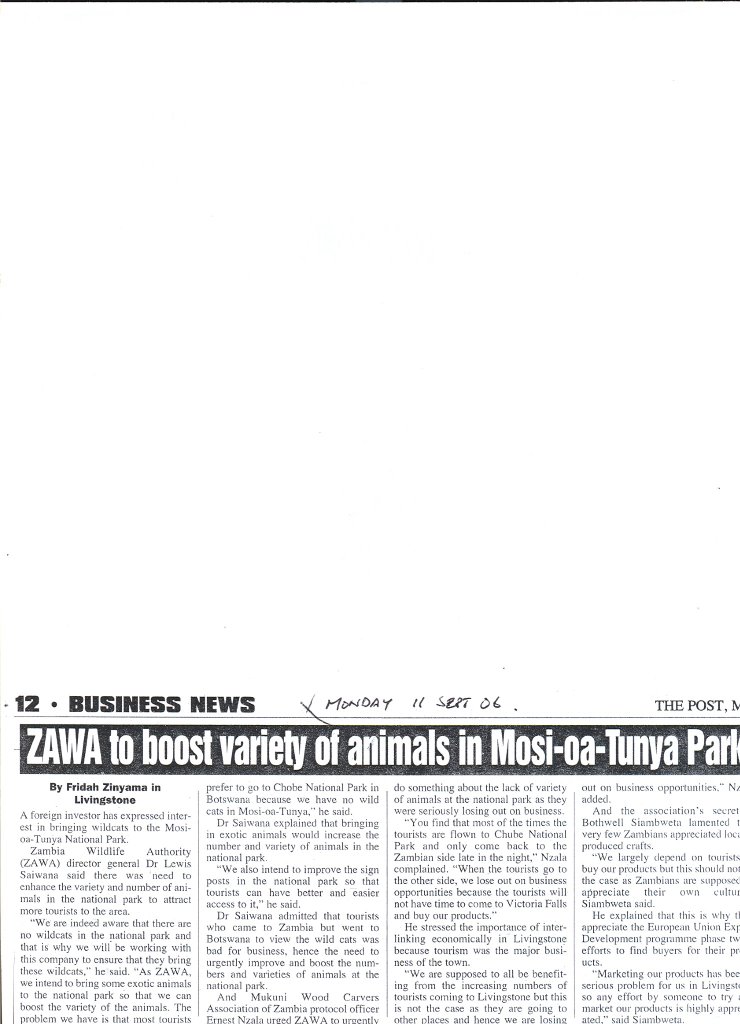
The Director General of the Zambia Wildlife Authority announces that a foreign investor will introduce wildcats into the Mosi oa Tunya National Park!
Friday, August 25, 2006
Fundis comment on the Proposed “Walking with Lions” Project
24 August 2006
Members of the international scientific community voice their serious concerns and strong opposition to the “Walking with Lions” tourist attraction currently being proposed by African Encounters and Safari par Excellence in Zambia. “Walking with Lions” is a purely commercial enterprise. The purported conservation value of a captive breeding and release program for lions has not been demonstrated. Indeed, many aspects of the proposed program appear ill conceived.
For example, hand rearing of lion cubs will ensure that these animals are imprinted to humans, and that they will thereafter lack natural avoidance behaviors. Teaching hand reared cubs to hunt as sub-adults will not decrease their dependence on humans, nor will it alter their imprinted behaviors. Indeed, semi-tame lions may be as dangerous as wild lions. Recently (August, 2006) in South Africa, three 2½ year-old lions escaped from a game farm and killed two workers. The lions were obtained as cubs and raised by hand. In Tanzania, wild lions kill nearly one hundred people each year, the majority of them villagers. Alteration of lion behavior through captive breeding, hand rearing, and release of semi-tame animals or their habituated offspring is both dangerous and irresponsible when considering the safety and welfare of humans and their livestock in Zambia.
“Walking with Lions” will require a constant supply of cubs. The possibility that this program would result in overbreeding of lions and subsequent development of a canned hunting industry in Zambia, or trade in surplus lions to canned hunting interests in other countries cannot be ignored. Fair hunting practices of wild lions are paramount to Zambia’s commercial hunting industry. For Zambia to associate itself in any way – either real or perceived – with canned hunting of lions could have far-reaching negative impacts on this industry. Currently, Zambia is moving towards ensuring the long-term protection and survival of its lion populations by supporting field research that examines distribution and abundance of lions countrywide, and a genetic assessment of lion subpopulations. It is also actively seeking to establish sustainable quotas through development and implementation of an age-based trophy selection program.
The claim that releasing captive bred lions into national parks and wild areas will serve any conservation purpose by augmenting lion numbers is wholly unsubstantiated. Further, it fails to take into account the genetic structure of lion subpopulations in Zambia. Far from proving advantageous, the released animals may, in fact, introduce deleterious genes or diseases into Zambia’s established wild lion populations, or otherwise alter the local adaptations of the naturally occurring genetic stocks.
Given reasonable protection from excessive mortality and sufficient food resources (e.g., game species), wild lions have the capacity to naturally repopulate a depleted area. In addition to conserving local genetic adaptations, the advantages of natural recovery versus introductions include greater stability to pride structure and movements, and greater predictability as to distance and direction of dispersers. Moreover, a naturally recovering predator population will exist at a density that is appropriate for both game populations and available habitat, thereby reducing the risk of conflict with humans and livestock.
It is emphasized here that “Walking with Lions” has no conservation value. If African Encounters and Safari par Excellence’s desire to assist with conservation of African lions is sincere, they will devote themselves to supporting established programs and organizations that are working towards the restoration and protection of Zambia’s wild lands and animals, and seek to educate their clientele in a similarly responsible fashion.
Dr. Paula A. White, Director, Zambia Lion Project
Center for Tropical Research, University of California, Los Angeles, USA
Dr. Craig Packer, Professor, Department of Ecology, Evolution, and Behavior
University of Minnesota, USA
Dr. Luke Hunter, Director, Great Cats Program
Wildlife Conservation Society, New York, USA
Members of the international scientific community voice their serious concerns and strong opposition to the “Walking with Lions” tourist attraction currently being proposed by African Encounters and Safari par Excellence in Zambia. “Walking with Lions” is a purely commercial enterprise. The purported conservation value of a captive breeding and release program for lions has not been demonstrated. Indeed, many aspects of the proposed program appear ill conceived.
For example, hand rearing of lion cubs will ensure that these animals are imprinted to humans, and that they will thereafter lack natural avoidance behaviors. Teaching hand reared cubs to hunt as sub-adults will not decrease their dependence on humans, nor will it alter their imprinted behaviors. Indeed, semi-tame lions may be as dangerous as wild lions. Recently (August, 2006) in South Africa, three 2½ year-old lions escaped from a game farm and killed two workers. The lions were obtained as cubs and raised by hand. In Tanzania, wild lions kill nearly one hundred people each year, the majority of them villagers. Alteration of lion behavior through captive breeding, hand rearing, and release of semi-tame animals or their habituated offspring is both dangerous and irresponsible when considering the safety and welfare of humans and their livestock in Zambia.
“Walking with Lions” will require a constant supply of cubs. The possibility that this program would result in overbreeding of lions and subsequent development of a canned hunting industry in Zambia, or trade in surplus lions to canned hunting interests in other countries cannot be ignored. Fair hunting practices of wild lions are paramount to Zambia’s commercial hunting industry. For Zambia to associate itself in any way – either real or perceived – with canned hunting of lions could have far-reaching negative impacts on this industry. Currently, Zambia is moving towards ensuring the long-term protection and survival of its lion populations by supporting field research that examines distribution and abundance of lions countrywide, and a genetic assessment of lion subpopulations. It is also actively seeking to establish sustainable quotas through development and implementation of an age-based trophy selection program.
The claim that releasing captive bred lions into national parks and wild areas will serve any conservation purpose by augmenting lion numbers is wholly unsubstantiated. Further, it fails to take into account the genetic structure of lion subpopulations in Zambia. Far from proving advantageous, the released animals may, in fact, introduce deleterious genes or diseases into Zambia’s established wild lion populations, or otherwise alter the local adaptations of the naturally occurring genetic stocks.
Given reasonable protection from excessive mortality and sufficient food resources (e.g., game species), wild lions have the capacity to naturally repopulate a depleted area. In addition to conserving local genetic adaptations, the advantages of natural recovery versus introductions include greater stability to pride structure and movements, and greater predictability as to distance and direction of dispersers. Moreover, a naturally recovering predator population will exist at a density that is appropriate for both game populations and available habitat, thereby reducing the risk of conflict with humans and livestock.
It is emphasized here that “Walking with Lions” has no conservation value. If African Encounters and Safari par Excellence’s desire to assist with conservation of African lions is sincere, they will devote themselves to supporting established programs and organizations that are working towards the restoration and protection of Zambia’s wild lands and animals, and seek to educate their clientele in a similarly responsible fashion.
Dr. Paula A. White, Director, Zambia Lion Project
Center for Tropical Research, University of California, Los Angeles, USA
Dr. Craig Packer, Professor, Department of Ecology, Evolution, and Behavior
University of Minnesota, USA
Dr. Luke Hunter, Director, Great Cats Program
Wildlife Conservation Society, New York, USA
Saturday, August 05, 2006
Following the western liberal tradition...
The main concern about the lion is not so much the canned lion hunting but the genetic implications of releasing lion into wild populations, and the impacts of semi-tame lion on villagers.
We don't need canned lion hunting to take pressure off wild populations: what we require is for a competent authority to manage hunting offtakes and to ensure that breeding animals are not shot. Research on lion clearly shows that shooting non-breeding males - as with any species, maintains the necessary genetic vigour. It is the killing of young pride lion which is the problem, as is the shooting of breeding bulls from buffalo herds. A trophy monitoring system needs to be implemented given the farcical and larcenous 'quota' system currently in place. The failure to introduce a monitoring system will lead us inevitably to lion being placed on Appendix 1 of CITES with all sorts of ramifications for rural development.
We need the lion project people to make a case for what they appear to have permission from ZAWA to do. But they must realize that going ahead with the takeover of a forest reserve (who gave them permission?) without an EIA from ECZ and all the other permissions and clearances required, is unwise. There are international standards and conventions in place here, as well as acceptance of a Western liberal democratic tradition - despite the corruption and the cavalier signing off of our resources. But these things require to be defended, the cant, humbug and hypocrisy punctured, the misguided and corrupt decision makers exposed. Zambia signed up for the principles of the Commission for Africa, as a result of which the G8 wrote off the debt. Let the Government now live up to its part of the bargain, and let the donors develop some backbone. Meanwhile, we, the ham in the sandwich...!
We don't need canned lion hunting to take pressure off wild populations: what we require is for a competent authority to manage hunting offtakes and to ensure that breeding animals are not shot. Research on lion clearly shows that shooting non-breeding males - as with any species, maintains the necessary genetic vigour. It is the killing of young pride lion which is the problem, as is the shooting of breeding bulls from buffalo herds. A trophy monitoring system needs to be implemented given the farcical and larcenous 'quota' system currently in place. The failure to introduce a monitoring system will lead us inevitably to lion being placed on Appendix 1 of CITES with all sorts of ramifications for rural development.
We need the lion project people to make a case for what they appear to have permission from ZAWA to do. But they must realize that going ahead with the takeover of a forest reserve (who gave them permission?) without an EIA from ECZ and all the other permissions and clearances required, is unwise. There are international standards and conventions in place here, as well as acceptance of a Western liberal democratic tradition - despite the corruption and the cavalier signing off of our resources. But these things require to be defended, the cant, humbug and hypocrisy punctured, the misguided and corrupt decision makers exposed. Zambia signed up for the principles of the Commission for Africa, as a result of which the G8 wrote off the debt. Let the Government now live up to its part of the bargain, and let the donors develop some backbone. Meanwhile, we, the ham in the sandwich...!
Mike Musgrave, Chairman of Livingstone WECSZ...
The blog doesn't give a complete picture of what is going on the
ground. There is a lot of concern which ranges from the hysterical to the
legitimate. I think the main concern comes from the possibility of the
excess lions going into canned hunting operations. I know Andy
Connolly said that would not happen but he has no control over lions
once he sells them. Personally I think canned lion hunting could be done
ethically and take the pressure off wild lion populations, but because it has been
done so badly in South Africa (shooting lions in small enclosures,
drugging lions etc etc), one can simply never justify it. All the
major hunting organisations (SCI being the biggest) have now comeout
strongly against this form of hunting. The major exceptions are bird
shoots which often use bred birds. My concern is that Zambia becomes
known as a canned lion hunting destination and this concern is shared
by the Professional Hunters Association.
ground. There is a lot of concern which ranges from the hysterical to the
legitimate. I think the main concern comes from the possibility of the
excess lions going into canned hunting operations. I know Andy
Connolly said that would not happen but he has no control over lions
once he sells them. Personally I think canned lion hunting could be done
ethically and take the pressure off wild lion populations, but because it has been
done so badly in South Africa (shooting lions in small enclosures,
drugging lions etc etc), one can simply never justify it. All the
major hunting organisations (SCI being the biggest) have now comeout
strongly against this form of hunting. The major exceptions are bird
shoots which often use bred birds. My concern is that Zambia becomes
known as a canned lion hunting destination and this concern is shared
by the Professional Hunters Association.
Wednesday, August 02, 2006
Professional Hunters Statement
"We are happy to be quoted that we are opposed to this move: we are totally opposed to canned hunting and we are not convinced that captive breeding of Lion and their release is in the best interests of our own gene pool."
Simon Burgess
Chairman, Professional Hunters' Association of Zambia
Simon Burgess
Chairman, Professional Hunters' Association of Zambia
GOOD NEWS FROM SOUTH AFRICA
BANNING OF CANNED HUNTING AND CAPTIVE BREEDING OF PREDATORS
The South African Minister for Environmental Affairs and Tourism, Martinus van Schalkwyk issued two draft regulations on Tuesday, May 2, 2006 regarding threatened and protected species and the much-anticipated draft National Norms and Standards for the Regulation of the Hunting Industry. These are available on the Department’s website at www.environment.gov.za
The new regulations would put an end to unethical game hunting: canned hunting (the shooting of animals in enclosures which allow no means of escape), the captive breeding of predators other than for conservation purposes, the trade in exotics and the translocation of species from outside their natural range. The regulations ban the intensive breeding of listed large predators such as cheetah, lion and leopard, unless it has an express conservation purpose. “In effect,” said the Minister, “The days of captive breeding of listed species for any purposes except science and conservation, are over. Large predators kept in captivity can no longer be hunted which has not been rehabilitated in an extensive wildlife system and been fending for itself in the wild for at least two years.”
Hunting will now be strictly regulated, being required to adopt fair-chase principles and humane methods, conducted by certified professional hunters adhering to sustainable game off-take quotas. The International Fund for Animal Welfare (IFAW), one of the organizations campaigning for tougher controls, welcomed the draft regulations. Jason Bell-Leask, the organization's southern Africa director, commented, "Let's hope they go far enough to address unethical hunting practices and, in the words of the minister, rid this cancer from society". Other African countries need to introduce preventative and protective legislation without delay so as to halt the stealthy invasion of the canned hunting / captive breeding industry. Namibia already has an active canned hunting industry, as does Zimbabwe.
The owner of Antelope Park, Andrew Connolly admitted at the WECSZ talk by Ian Michler on the “Captive Breeding of Predators and Canned Hunting” held in February 2006 in Livingstone, that he had sold 35 lion to three breeders in South Africa four years ago. When asked if he was aware that these breeders were canned hunters, he said he was not aware. The main question is, if the Livingstone Walking with Lion release programme is unsuccessful, what will happen to the surplus lion once they have outgrown the money-making walks. Are we introducing “put and take hunts” in Zambia?
Ali Shenton
Wildlife & Environmental Conservation Society of Zambia (Livingstone Branch)
The South African Minister for Environmental Affairs and Tourism, Martinus van Schalkwyk issued two draft regulations on Tuesday, May 2, 2006 regarding threatened and protected species and the much-anticipated draft National Norms and Standards for the Regulation of the Hunting Industry. These are available on the Department’s website at www.environment.gov.za
The new regulations would put an end to unethical game hunting: canned hunting (the shooting of animals in enclosures which allow no means of escape), the captive breeding of predators other than for conservation purposes, the trade in exotics and the translocation of species from outside their natural range. The regulations ban the intensive breeding of listed large predators such as cheetah, lion and leopard, unless it has an express conservation purpose. “In effect,” said the Minister, “The days of captive breeding of listed species for any purposes except science and conservation, are over. Large predators kept in captivity can no longer be hunted which has not been rehabilitated in an extensive wildlife system and been fending for itself in the wild for at least two years.”
Hunting will now be strictly regulated, being required to adopt fair-chase principles and humane methods, conducted by certified professional hunters adhering to sustainable game off-take quotas. The International Fund for Animal Welfare (IFAW), one of the organizations campaigning for tougher controls, welcomed the draft regulations. Jason Bell-Leask, the organization's southern Africa director, commented, "Let's hope they go far enough to address unethical hunting practices and, in the words of the minister, rid this cancer from society". Other African countries need to introduce preventative and protective legislation without delay so as to halt the stealthy invasion of the canned hunting / captive breeding industry. Namibia already has an active canned hunting industry, as does Zimbabwe.
The owner of Antelope Park, Andrew Connolly admitted at the WECSZ talk by Ian Michler on the “Captive Breeding of Predators and Canned Hunting” held in February 2006 in Livingstone, that he had sold 35 lion to three breeders in South Africa four years ago. When asked if he was aware that these breeders were canned hunters, he said he was not aware. The main question is, if the Livingstone Walking with Lion release programme is unsuccessful, what will happen to the surplus lion once they have outgrown the money-making walks. Are we introducing “put and take hunts” in Zambia?
Ali Shenton
Wildlife & Environmental Conservation Society of Zambia (Livingstone Branch)
Wednesday, July 26, 2006
NO EIA FOR LIVINGSTONE LION PROJECT
The Environmental Council of Zambia has told WECSZ that no EIA had been received in respect of the Livingstone lion project, that in fact that they had not heard of it! The Livingstone branch of WECSZ reports that the project has started.
CAPTIVE BREEDING LEGISLATION
POLICY AND LEGISLATION
A NOTE
In Zambia, we have yet to see issued regulations accompanying the Wildlife Act of 1998 on game ranching and captive breeding – in the first draft, studied at the Natural Resources Consultative Forum (NRCF) meeting, being hopelessly muddled. This regulation, with some stakeholders hurried inputs – others more considered inputs not being included, were taken off by legal consultants who clearly knew nothing of the issues they had been asked to deal with, and by the Zambia Wildlife Authority (ZAWA), a statutory body now without any credible scientific capability where financial budgetary considerations outweigh those of biodiversity conservation – a necessity foisted on them by the misguided decision to replace the Department of National Parks and Wildlife with a statutory body, one required to ‘pay its way’.
The imperatives of good sense and personal and biodiversity community ethical judgement, supported by the draft National Policy on Environment (NPE), require that we study new proposals and developments carefully so as to adjudge whether they impact negatively, or positively, on our biodiversity. It may be that after careful consideration – working through our cross-sectoral forum, the NRCF, that the Walking With Lions Park in Livingstone will not be in conflict with the NPE; but this we must decide in open forum. At the moment, as with the continuation of the Mosi-oa-Tunya National Park land-grab - a national and global disgrace, ZAWA acts as a runaway horse, without the jockey (ZAWA Board) required to avoid the strolling prams. THE PRICE OF ALL THIS IS ETERNAL VIGILANCE!
A NOTE
In Zambia, we have yet to see issued regulations accompanying the Wildlife Act of 1998 on game ranching and captive breeding – in the first draft, studied at the Natural Resources Consultative Forum (NRCF) meeting, being hopelessly muddled. This regulation, with some stakeholders hurried inputs – others more considered inputs not being included, were taken off by legal consultants who clearly knew nothing of the issues they had been asked to deal with, and by the Zambia Wildlife Authority (ZAWA), a statutory body now without any credible scientific capability where financial budgetary considerations outweigh those of biodiversity conservation – a necessity foisted on them by the misguided decision to replace the Department of National Parks and Wildlife with a statutory body, one required to ‘pay its way’.
The imperatives of good sense and personal and biodiversity community ethical judgement, supported by the draft National Policy on Environment (NPE), require that we study new proposals and developments carefully so as to adjudge whether they impact negatively, or positively, on our biodiversity. It may be that after careful consideration – working through our cross-sectoral forum, the NRCF, that the Walking With Lions Park in Livingstone will not be in conflict with the NPE; but this we must decide in open forum. At the moment, as with the continuation of the Mosi-oa-Tunya National Park land-grab - a national and global disgrace, ZAWA acts as a runaway horse, without the jockey (ZAWA Board) required to avoid the strolling prams. THE PRICE OF ALL THIS IS ETERNAL VIGILANCE!
WALKING WITH LIONS AND CAPTIVE BREEDING IN ZAMBIA
Walking with Lions and Captive Breeding in Zambia
Livingstone branch of the Wildlife and Environmental Conservation Society of Zambia (WECSZ)
June 2006
African Encounters, with Safari par Excellence, are planning to set up a captive lion breeding/tourist attraction in the Mosi-o-Tunya National Park, near Livingstone, and the nearby Dambwa Forest Reserve. The offspring of these lions will then be relocated to the wild to replenish depleted lion populations On the African Encounter Website (ww.africanencounter.org/lions) it states that “captive bred lions can and have been rehabilitated to the wild. In South Africa this is confirmed by senior ecologists and conservationists”.
Lionesses and cubs will be imported from an existing operation in Victoria Falls, Zimbabwe and a breeding male lion from Tanzania to start the project. Cubs will be removed from the mother for hand-raising and habituated to humans for wildlife walks and when too big/dangerous at 12 - 16 months, will be transferred to enclosure(s) in the Dambwa Forest Reserve for wild-release training and “semi-captive” breeding. Second generation animals from Dambwa will then be released into areas where the lion population has decreased e.g. the Kafue National Park, and presumably into GMAs, where the real shortage of lions exists. (For more information on the project: www.antelopepark.co.zw; www.lionencounter.com; www.safpar.com)
The Society’s concerns are several:
Captive breeding: The commercial breeding of lions has never been conducted in Zambia. Neither, to our knowledge, has the reintroduction of lions into the wild been successful anywhere else in the world. In light of these considerations and the South African experiences illustrated by Michler (page 14) we believe that the project warrants serious, prior, policy consideration
Reintroduction to the wild: Because the pride structure is absent in captive bred breeding programs, the rehabilitation process is arduous, and although attempted by Norman Carr, George Adamson and Gareth Patterson, has not been successful to the extent of integrating these lions into free roaming prides and achieving successful breeding from them. Dr. Paula White, researcher for Predator Research, who has worked on wild lion populations in Zambia including in Kafue National Park states: “An individual lion being released that way probably has an extremely low chance of survival, even lower chance of establishing itself as a breeding animal, and lower still of producing any surviving offspring even if it does manage to mate. A cohort of lions released together would have a better chance, but there are still issues of territory and hunting technique, the latter of which may be specific to region and prey base”.
The Ethical Conservation Network states that “to our knowledge, lions bred in captivity are never used by national parks or game reserves to establish lion populations, to augment free-ranging lion populations or to introduce new genes to free ranging populations. National parks and game reserves wishing to acquire lions for whatever reason take one or more prides of free-ranging wild lions from other national parks and game reserves. No conservation benefit derives from the breeding of lions in captivity. To claim otherwise is to attempt to put a conservation value on a purely commercial enterprise.” Dr White says, “Rehab rarely works for the animal. Agencies do it for PR, individual volunteers do it with the best of intentions, but the “freed” animals are usually never seen again. Because lions are so territorial, continual dumping of lions into an area would result in a lot of dispersers. This could provide additional huntable lions to GMAs, but it could also result in a lot of problems with hungry, displaced lions moving into human-settled areas and killing livestock and/or people. The African Encounters Mission Statement states that it is: “researching the introduction of captive breeding lions into the wild”, but does not claim any success in actually doing so. At this stage the rehabilitation process is still in a “research” stage. Since 1972, to our knowledge, none of Antelope Park’s lions have been reintroduced to the wild.
The Future of Surplus Human-Imprinted Lions
Technical Issues: Overstocking: The project anticipates up to twelve cubs a year. For the commercial operation, a constant supply of cubs is needed. Once these domesticated cubs are too big to walk with tourists, they are translocated into the fenced enclosures. Their off spring are to be released into the wild. At what density are the lions to be kept in these enclosures? How many enclosures are planned for with how many lions over say a five year period. The necessary stocking rate of lion fodder (live game) will also have a major impact on the environment (Dambwa forest Reserve) – quite part from its practicality.
Antelope Park claims to have a further 14 breeding programs / reserves in the offing. These to be situated in Uganda, Mozambique and a number of other African countries. Surplus “human imprinted” lion from Zambia will be relocated to these reserves and the breeding program will be continued in these countries. Have relocations conducted in this manner ever been successfully carried out before. If so, where? If not, and the lions are unable to be released, what is the policy towards protecting the lions from becoming part of the “excess” of captive bred lions which end up in illegal animal trade or canned or staged hunts. Most breeding centers serve little or no conservation value beyond offering a zoo experience and many owners have been accused of providing lions for canned hunting, although most deny this charge.
“As certain species are bred to excess, individual animals, unwanted and often uncared for, face an ominous future.” In recent years, to cope with this over breeding, an animal trade network has developed between captive breeders, circuses, zoos, research laboratories, the illegal animal trade especially to the Middle East and the canned hunting industry, often with specialized animal dealers acting as well-paid intermediaries. “One might well ask why measures are not taken to prevent over-breeding in the beast wagon. The answer, unfortunately, is that over-breeding, particularly of lions, tigers and leopards, is actively encouraged because those cute and fluffy cubs remain one of the star attractions of commercial enterprises”. Endangered Species in Abundance: Captive Breeding and Overbreeding of Lions www.irridescent-publishing.com
Policy, legislative and procedural: Does existing legislation permit the project? If yes, is the policy/legislation/regulatory framework robust enough to monitor the project adequately and ensure the necessary safeguards? If not what is needed to address loop-holes and omissions? Has the necessary environmental impact legislation and procedure been followed properly?
Ethics: Do the breeding ethics of this project conform to global animal welfare standards? What are the ethics of removing cubs as young as a week to three weeks old from their mother for hand raising, so the cubs can be easier handled for commercial walks. This is done for three reasons - to bring the mother into another oestrus cycle so she can be mated again. - the cubs will be imprinted by humans from a very early age so they are easier to handle as they grow up - this keeps the breeding/hunting/tourist operation with a constant supply of young cubs for tourist attractions, walks with lions, or for sale to other breeders and collectors. Captive lions can live to around twelve years old and are therefore producing double their natural litters. Breeders often argue that the removal of cubs at an early age is because the mother is a “bad mother”. Certainly, a lioness giving birth in artificial, unnatural circumstances can very easily become a “bad mother” due to the stress related to the captive environment. A lioness that has had her cubs removed at a very early age becomes visibly distressed. This practice is therefore considered inhumane and unethical.
Allied to canned hunting is captive breeding. These are the facilities that supply the canned hunting industry and also for the local and international and international wildlife trade. In the past Antelope park has sold lions to captive breeders in South Africa who are involved in the canned hunting industry. We are concerned over the ethics of such practice as it speaks of commercial gain and not conservation Helen Dagut, Campaigns Manager for IFAW Southern Africa, states “If captive breeding, other than for bona fide conservation purposes, was banned, we would rapidly see the demise of “canned hunting” and the indiscriminate trade of our wildlife.” The society is concerned that a surplus of “domesticated” lions could filter into the canned hunting industry in Southern Africa or lead to a canned hunting industry in Zambia or in other African countries.
Biodiversity: Zambia is a signatory to the Convention on Biological Diversity (CBD) and should abide by the objectives of that convention. Michler states that breeding programs often use the guise of conservation i.e. to preserve and promote the genetic diversity of lions for example to conserve the gene pool. Breeding programs do not always adhere to the convention of biological diversity www.biodiver.org, the principles of which recognize the integrity of species and subspecies in the environment in which they evolve. Dr. White, states ”If it was suitable (politically, biologically, etc.) that an existing wild lion population be augmented by releasing additional lions, say perhaps southern Kafue where lion may not be as plentiful, it would be best from both a sub-population and ecological standpoint to release lion that were as close genetically to the existing population as possible”. Is this project compatible with CBD as stated? Is the project necessary from a Zambian biodiversity conservation viewpoint?
”The genetic implications of zoo or captured wild lion moved to a safari park, is huge – particularly if of a different genetic stock to that of the ‘local lion’. We have the evidence of zoo lion: long confined, fed by man and without the daily imperatives of survival, metamorphosed into an animal having with time an increasingly different genetic relationship with wild lion – the only true lion, because they suffer the curse of inbreeding, of the doubling of malign genes, of confinement. Safari park lion have, like domesticated dogs, come under the considerable selective force of man already, being moulded and changed to fit his design; they too will lose their fitness, will increasingly become domesticated, one day perhaps bearing as much relationship with a real lion as does the Chihuahua and the St Bernard with its ancient ancestor.” Ian Manning
Conservation: The justification behind this project is that second generation lions will be released in the wild in places where populations are low. To date the Society does not know of a single successful lion wild release project and the only attempts that are commonly known were effectively one-on-one programs. This should not mean the rejection of properly structured and planned biodiversity-oriented research programs: a) because captive breeding and wild release in other species has been successful in some cases; and b) lion populations are under threat – mainly from poaching, range encroachment by man, and from safari hunting. But does this project match Zambia’s needs or is it being externally driven with other objectives? Is it a sufficient priority to place in a funding queue ahead of other more urgent requirements? Dambwa Forest Reserve is currently a Joint Forest Management pilot area and part of an elephant movement and feeding route. Should these requirements be laid aside in order to accommodate non-compatible tourism plans?
Commercialism: Mixing commercial and scientific objectives is difficult. Is this primarily a commercial, or a biodiversity conservation project? If the former, are the biodiversity objectives not subverted? If the latter, is it effectively designed with carefully calculated and desirable objectives and outputs that will contain commercial objectives?
Canned hunting experience from zoos worldwide suggests that lions breed well in captivity (because of the removal of most competition, predation, disease and accidental-related losses). Unless the breeding program matches the release rate there is an inevitable build-up of numbers. South African experience indicates that as long as a wildlife trading network exists, the natural end point for this problem is the establishment of a lucrative canned hunting business capable of absorbing the surpluses. Will this project not amount to a self-fulfilling prophesy.
If the Zambian hunting industry was linked to canned hunting in South Africa it could seriously tarnish our hunting credentials through a negative response from the international conservation community. In South Africa lion trophies are no longer accepted in the record books of Safari Club International / Roland Ward as a result of the irregularities in the hunting industry due to canned hunting.
“Whatever one’s sentiments and opinion are, we all have to agree that this method of breeding large predators for hunting has branded South Africa as the skunk of the international conservation community. Hunting ethics in South Africa is at an all time low and respected conservationists are becoming more and more concerned by the day as they are of the opinion that the good conservation record they built up for South Africa 30-40 years ago are currently being soiled by unethical conservation and hunting practices. South Africans, many of them involved in the commercial utilization of wild animals are no longer practicing sound conservation principles, but are fast gaining a reputation for selective species conservation.”
www.sanwild.org/NOTICEBOARD/news2005/What is going down South for the African Lion July 08 2005
In South Africa “there is hope for a full ban on canned hunting and the implementation of restrictions on those breeding large predators”. Marthinus van Schalkwyk, the Minister of Environmental Affairs and Tourism is reviewing the recommendations and findings of a panel of experts who are calling for a ban on the hunting of captive bred predators (canned hunting and “put and take” hunting), a ban on the import of all alien species for hunting and legislation that bans a species from being translocated outside of their range zones. Ian Michler Africa Geographic February 2006. Because of the depth of concern about these issues the South African government will debate a bill proposing the banning of this industry this year.
While South Africa attempts to control and legislate this industry Zambia is in a position to act wisely and with precaution. By setting regulations and laying down legislation now, we can not only prevent a situation developing like South Africa’s but also make a stand on the international conservation forum.
Livingstone branch of the Wildlife and Environmental Conservation Society of Zambia (WECSZ)
June 2006
African Encounters, with Safari par Excellence, are planning to set up a captive lion breeding/tourist attraction in the Mosi-o-Tunya National Park, near Livingstone, and the nearby Dambwa Forest Reserve. The offspring of these lions will then be relocated to the wild to replenish depleted lion populations On the African Encounter Website (ww.africanencounter.org/lions) it states that “captive bred lions can and have been rehabilitated to the wild. In South Africa this is confirmed by senior ecologists and conservationists”.
Lionesses and cubs will be imported from an existing operation in Victoria Falls, Zimbabwe and a breeding male lion from Tanzania to start the project. Cubs will be removed from the mother for hand-raising and habituated to humans for wildlife walks and when too big/dangerous at 12 - 16 months, will be transferred to enclosure(s) in the Dambwa Forest Reserve for wild-release training and “semi-captive” breeding. Second generation animals from Dambwa will then be released into areas where the lion population has decreased e.g. the Kafue National Park, and presumably into GMAs, where the real shortage of lions exists. (For more information on the project: www.antelopepark.co.zw; www.lionencounter.com; www.safpar.com)
The Society’s concerns are several:
Captive breeding: The commercial breeding of lions has never been conducted in Zambia. Neither, to our knowledge, has the reintroduction of lions into the wild been successful anywhere else in the world. In light of these considerations and the South African experiences illustrated by Michler (page 14) we believe that the project warrants serious, prior, policy consideration
Reintroduction to the wild: Because the pride structure is absent in captive bred breeding programs, the rehabilitation process is arduous, and although attempted by Norman Carr, George Adamson and Gareth Patterson, has not been successful to the extent of integrating these lions into free roaming prides and achieving successful breeding from them. Dr. Paula White, researcher for Predator Research, who has worked on wild lion populations in Zambia including in Kafue National Park states: “An individual lion being released that way probably has an extremely low chance of survival, even lower chance of establishing itself as a breeding animal, and lower still of producing any surviving offspring even if it does manage to mate. A cohort of lions released together would have a better chance, but there are still issues of territory and hunting technique, the latter of which may be specific to region and prey base”.
The Ethical Conservation Network states that “to our knowledge, lions bred in captivity are never used by national parks or game reserves to establish lion populations, to augment free-ranging lion populations or to introduce new genes to free ranging populations. National parks and game reserves wishing to acquire lions for whatever reason take one or more prides of free-ranging wild lions from other national parks and game reserves. No conservation benefit derives from the breeding of lions in captivity. To claim otherwise is to attempt to put a conservation value on a purely commercial enterprise.” Dr White says, “Rehab rarely works for the animal. Agencies do it for PR, individual volunteers do it with the best of intentions, but the “freed” animals are usually never seen again. Because lions are so territorial, continual dumping of lions into an area would result in a lot of dispersers. This could provide additional huntable lions to GMAs, but it could also result in a lot of problems with hungry, displaced lions moving into human-settled areas and killing livestock and/or people. The African Encounters Mission Statement states that it is: “researching the introduction of captive breeding lions into the wild”, but does not claim any success in actually doing so. At this stage the rehabilitation process is still in a “research” stage. Since 1972, to our knowledge, none of Antelope Park’s lions have been reintroduced to the wild.
The Future of Surplus Human-Imprinted Lions
Technical Issues: Overstocking: The project anticipates up to twelve cubs a year. For the commercial operation, a constant supply of cubs is needed. Once these domesticated cubs are too big to walk with tourists, they are translocated into the fenced enclosures. Their off spring are to be released into the wild. At what density are the lions to be kept in these enclosures? How many enclosures are planned for with how many lions over say a five year period. The necessary stocking rate of lion fodder (live game) will also have a major impact on the environment (Dambwa forest Reserve) – quite part from its practicality.
Antelope Park claims to have a further 14 breeding programs / reserves in the offing. These to be situated in Uganda, Mozambique and a number of other African countries. Surplus “human imprinted” lion from Zambia will be relocated to these reserves and the breeding program will be continued in these countries. Have relocations conducted in this manner ever been successfully carried out before. If so, where? If not, and the lions are unable to be released, what is the policy towards protecting the lions from becoming part of the “excess” of captive bred lions which end up in illegal animal trade or canned or staged hunts. Most breeding centers serve little or no conservation value beyond offering a zoo experience and many owners have been accused of providing lions for canned hunting, although most deny this charge.
“As certain species are bred to excess, individual animals, unwanted and often uncared for, face an ominous future.” In recent years, to cope with this over breeding, an animal trade network has developed between captive breeders, circuses, zoos, research laboratories, the illegal animal trade especially to the Middle East and the canned hunting industry, often with specialized animal dealers acting as well-paid intermediaries. “One might well ask why measures are not taken to prevent over-breeding in the beast wagon. The answer, unfortunately, is that over-breeding, particularly of lions, tigers and leopards, is actively encouraged because those cute and fluffy cubs remain one of the star attractions of commercial enterprises”. Endangered Species in Abundance: Captive Breeding and Overbreeding of Lions www.irridescent-publishing.com
Policy, legislative and procedural: Does existing legislation permit the project? If yes, is the policy/legislation/regulatory framework robust enough to monitor the project adequately and ensure the necessary safeguards? If not what is needed to address loop-holes and omissions? Has the necessary environmental impact legislation and procedure been followed properly?
Ethics: Do the breeding ethics of this project conform to global animal welfare standards? What are the ethics of removing cubs as young as a week to three weeks old from their mother for hand raising, so the cubs can be easier handled for commercial walks. This is done for three reasons - to bring the mother into another oestrus cycle so she can be mated again. - the cubs will be imprinted by humans from a very early age so they are easier to handle as they grow up - this keeps the breeding/hunting/tourist operation with a constant supply of young cubs for tourist attractions, walks with lions, or for sale to other breeders and collectors. Captive lions can live to around twelve years old and are therefore producing double their natural litters. Breeders often argue that the removal of cubs at an early age is because the mother is a “bad mother”. Certainly, a lioness giving birth in artificial, unnatural circumstances can very easily become a “bad mother” due to the stress related to the captive environment. A lioness that has had her cubs removed at a very early age becomes visibly distressed. This practice is therefore considered inhumane and unethical.
Allied to canned hunting is captive breeding. These are the facilities that supply the canned hunting industry and also for the local and international and international wildlife trade. In the past Antelope park has sold lions to captive breeders in South Africa who are involved in the canned hunting industry. We are concerned over the ethics of such practice as it speaks of commercial gain and not conservation Helen Dagut, Campaigns Manager for IFAW Southern Africa, states “If captive breeding, other than for bona fide conservation purposes, was banned, we would rapidly see the demise of “canned hunting” and the indiscriminate trade of our wildlife.” The society is concerned that a surplus of “domesticated” lions could filter into the canned hunting industry in Southern Africa or lead to a canned hunting industry in Zambia or in other African countries.
Biodiversity: Zambia is a signatory to the Convention on Biological Diversity (CBD) and should abide by the objectives of that convention. Michler states that breeding programs often use the guise of conservation i.e. to preserve and promote the genetic diversity of lions for example to conserve the gene pool. Breeding programs do not always adhere to the convention of biological diversity www.biodiver.org, the principles of which recognize the integrity of species and subspecies in the environment in which they evolve. Dr. White, states ”If it was suitable (politically, biologically, etc.) that an existing wild lion population be augmented by releasing additional lions, say perhaps southern Kafue where lion may not be as plentiful, it would be best from both a sub-population and ecological standpoint to release lion that were as close genetically to the existing population as possible”. Is this project compatible with CBD as stated? Is the project necessary from a Zambian biodiversity conservation viewpoint?
”The genetic implications of zoo or captured wild lion moved to a safari park, is huge – particularly if of a different genetic stock to that of the ‘local lion’. We have the evidence of zoo lion: long confined, fed by man and without the daily imperatives of survival, metamorphosed into an animal having with time an increasingly different genetic relationship with wild lion – the only true lion, because they suffer the curse of inbreeding, of the doubling of malign genes, of confinement. Safari park lion have, like domesticated dogs, come under the considerable selective force of man already, being moulded and changed to fit his design; they too will lose their fitness, will increasingly become domesticated, one day perhaps bearing as much relationship with a real lion as does the Chihuahua and the St Bernard with its ancient ancestor.” Ian Manning
Conservation: The justification behind this project is that second generation lions will be released in the wild in places where populations are low. To date the Society does not know of a single successful lion wild release project and the only attempts that are commonly known were effectively one-on-one programs. This should not mean the rejection of properly structured and planned biodiversity-oriented research programs: a) because captive breeding and wild release in other species has been successful in some cases; and b) lion populations are under threat – mainly from poaching, range encroachment by man, and from safari hunting. But does this project match Zambia’s needs or is it being externally driven with other objectives? Is it a sufficient priority to place in a funding queue ahead of other more urgent requirements? Dambwa Forest Reserve is currently a Joint Forest Management pilot area and part of an elephant movement and feeding route. Should these requirements be laid aside in order to accommodate non-compatible tourism plans?
Commercialism: Mixing commercial and scientific objectives is difficult. Is this primarily a commercial, or a biodiversity conservation project? If the former, are the biodiversity objectives not subverted? If the latter, is it effectively designed with carefully calculated and desirable objectives and outputs that will contain commercial objectives?
Canned hunting experience from zoos worldwide suggests that lions breed well in captivity (because of the removal of most competition, predation, disease and accidental-related losses). Unless the breeding program matches the release rate there is an inevitable build-up of numbers. South African experience indicates that as long as a wildlife trading network exists, the natural end point for this problem is the establishment of a lucrative canned hunting business capable of absorbing the surpluses. Will this project not amount to a self-fulfilling prophesy.
If the Zambian hunting industry was linked to canned hunting in South Africa it could seriously tarnish our hunting credentials through a negative response from the international conservation community. In South Africa lion trophies are no longer accepted in the record books of Safari Club International / Roland Ward as a result of the irregularities in the hunting industry due to canned hunting.
“Whatever one’s sentiments and opinion are, we all have to agree that this method of breeding large predators for hunting has branded South Africa as the skunk of the international conservation community. Hunting ethics in South Africa is at an all time low and respected conservationists are becoming more and more concerned by the day as they are of the opinion that the good conservation record they built up for South Africa 30-40 years ago are currently being soiled by unethical conservation and hunting practices. South Africans, many of them involved in the commercial utilization of wild animals are no longer practicing sound conservation principles, but are fast gaining a reputation for selective species conservation.”
www.sanwild.org/NOTICEBOARD/news2005/What is going down South for the African Lion July 08 2005
In South Africa “there is hope for a full ban on canned hunting and the implementation of restrictions on those breeding large predators”. Marthinus van Schalkwyk, the Minister of Environmental Affairs and Tourism is reviewing the recommendations and findings of a panel of experts who are calling for a ban on the hunting of captive bred predators (canned hunting and “put and take” hunting), a ban on the import of all alien species for hunting and legislation that bans a species from being translocated outside of their range zones. Ian Michler Africa Geographic February 2006. Because of the depth of concern about these issues the South African government will debate a bill proposing the banning of this industry this year.
While South Africa attempts to control and legislate this industry Zambia is in a position to act wisely and with precaution. By setting regulations and laying down legislation now, we can not only prevent a situation developing like South Africa’s but also make a stand on the international conservation forum.
Subscribe to:
Posts (Atom)